For an example of one such system using a tiny Nd:YAG laser rod pumped by the electronic flash unit from a disposable (single use) 35 mm pocket camera, see the paper: Micro-Laser Range Finder Development: Using the Monolithic Approach.
                      (difference frequency) * c
          Distance = ----------------------------
                           2 * (chirp rate)
Where c is the velocity of light.
Dynamic implementation in the form of a laser scanner can actually be used to implement a 3-D profile measurement system. If a laser beam is scanned across a 3-D object, and the spot is viewed (by optical sensors) from two different locations, it is possible to determine the instantaneous distance to the spot (on the object). This can be down digitally (using a pair of CCD cameras - slow) or analog using a pair of 4-quadrant photodiodes. With a more constrained system (see below), only a single sensor is needed. This isn't a simple project either but at least doesn't depend on precision on the order of the wavelength of light! Such scanners exist and are used in conjunction with robotics (and other research), in industrial CAD/CAM for construction of computer models from real-world objects, and many other applications.
(From: Steve Roberts (osteven@akrobiz.com).)
One approach is to use a frame grabber, a translation stage, and a simple laser with a simple line generating optic. You put the piece to be scanned on the translation stage, shoot the line onto it from above and look at it with the camera. The line creates a cross-section of one small part of the object and the camera records it. Then you process out the laser light from the background, advance the translation stage one more linewidth, and take the next slice and so on - sort of a crude from of computed tomography.
(From: Paul Mathews (optoeng@whidbey.com).)
You might want to look at some modules designed for this purpose. The Sharp's Distance Measuring Sensors are compact and sensitive. They include the emitter LED, detector photodiodes, and signal processing circuitry in a compact integrated module.
There are also some nice application notes available from Hamamatsu for use with their Position Sensing Diodes and related ICs.
Manufactures/suppliers of devices used in laser rangefinders include: E-O Devices and Analog Modules.
          To distant scene.
          ^               ^
          |               |
          |       C/------/D
          |A       |
          \--------\       (B is partially silvered or a half mirror to
         adjust   B|        permit viewing of both sides from the scene.)
         angle     ^
               view here
          |               |
          |<- baseline -->|
The further apart the mirrors are (size of baseline), the greater the useful
range. Adjust the angle of mirror A or D until the images are
superimposed. Calibrate the angular setting to distance.
The distance from A to the scene is then: tan(angle A) * baseline.
For long distances, C and D can be eliminated - they compensate for the difference in path lengths of the two views - else the sizes would not be the same. (Even this doesn't work perfectly in any case. Can you figure out why?)
You can add telescopes and other optics if you like - this is just the basics.
Look Ma, no electronics. :-)
Note that SLR cameras do NOT use this approach as they are entirely optical (meaning that adjusting the focus only controls the lens - nothing else!). With SLRs, a pair of shallow prisms oriented in opposite directions (or many in the case of a 'microscreen' type) are cemented onto a clear area of the ground glass. When the image is precisely focused onto the ground glass, the prisms have no effect. However, when the image is in front or behind, they divert the rays such that the two halves of the image move apart (or the image breaks up in the case of the 'microscreen').
There were some "Amateur Scientist" articles in Scientific American a few decades ago on constructing several types of optical range finders. These were included in the book, "Light and Its Uses". See the section: A HREF="laserclt.htm#cltsi">Scientific American Articles on Lasers and Related Topics.
My students construct a simple laser rangefinder using a few basic parts:
Equipment:
Basic procedure:
Rough diagram of rangefinder setup:
               To wall                    To wall
                 ^                           ^
                 |                             \
        distance | first reflected beam          \ second reflected beam
                 |                                 \
                 |                             angle \
    Laser --3"---/------------------------------------/
            Beam splitter                    Rotary table with mirror
                 |<------------- 6 feet ------------->|
Of course, you can make the non-laser version of this type of rangefinder (but
this is a laser FAQ! --- sam). My students also make that one as well. Both
are pretty neat and demonstrate the power of trig to determine distances!
I am just finishing the development of a range finder based on the TOF (pulse-Time-Of-Flight) measurement method. There are also different methods like phase-shift method which compares the phase shift between outgoing modulated beam and reflected light.
The Pulse TOF method has some advantages which make it very useful: you can use relatively high pulse power and still be in the Class I safety range.
While building such a range finder there are two crucial components which have influence on its accuracy: the time measurement circuits and the receiver. Our aim was to build a laser scanner with the resolution of 1 cm which means that you have to be able to measure the time with the resolution of 67 ps. The range of the scanner should be approx. 30m. We are not ready yet but there are some results.
For the first prototype we used a 1.25 GHz oscillator and special microstrip design to get the resolution of 70 ps. In the current prototype we use a special prototype IC which should deliver 50 ps resolution.
The problems are on the receiver side, a relatively large jitter (which I'm fighting now) destroys my high time measurement precision. The jitter on the input results in the distance differences of approximately 10 cm). This can be filtered out by averaging of a number of measurements and that is what we are doing now. Our measurement frequency is at present 100 kHz, but we will probably perform the averaging over 10 measurements so that effective measurement rate will be 10 kHz.
(From: jfd (jezebel@snet.net).)
The problem is getting simultaneous long standoff range and extremely accurate range. You can phase detect with accuracies in the sub-inch range using direct detected RF modulated LIDARS or you can use an interferometric technique with a reference to get sub-micron distances.
(From: Robert (romapa@earthlink.net).)
For much better resolution than would be possible with simple sampling while still maintaining low cost, digital TOF rangefinders can combine a precision analog temporal interpolator with say a CMOS system running at 100 MHz. The analog circuitry to accomplish this is in many production units (for different applications) - but 5 ps resolution has been achieved with low-cost components and in production for 15 years from at least one manufacturer. The idea is interpolate between the digital count periods with a precision time-to-voltage converter which is then sampled by microcontroller and combined with the digital counter results.
(From: Bill Sloman (bill_sloman@my-deja.com).)
You may be able to achieve this at low unit cost, but getting a precision analog temporal interpolator to work well next to CMOS running at 100 MHz isn't something I'd describe as easy.
We developed a system of this sort at Cambridge Instruments between 1988 and 1991 using a mixture of 100K ECL and GigaBit Logic's GaAs for the digital logic. Any digital signal going to or from the analog temporal interpolator was routed as a balanced pair on adjacent tracks, and we were very careful about the layout, but we still had to work at getting the noise on the interpolator output down to the 60 picosecond jitter on our 800 MHz master clock (getting a better master clock was the next priority).
Current-steering logic (like ECL and GaAs) is a lot quieter than voltage-steering logic (like TTL and CMOS), which is why very fast DACs and ADCs use ECL interfaces. Precision analog interpolators are no less sensitive.
Do you know who has actually achieved that 5 ps resolution and for what application? Tektronix and time domain reflectometers come to mind, though Tektronix isn't exactly cheap. IIRR Triquint was originally their in-house analog foundry and I think Tektronix has been using GaAs ASICs in their faster gear for quite some time now.
The hybrid approach certainly isn't new, but getting it to work is a fair test of one's analog skills.
Of course, using phase-shift not only makes for easier circuit design, but also lets you run your LED at a 50% duty cycle, giving you a lot more reflected photons to work with than the 0.01% you get with TOF.
(From: Lou Boyd (boyd@fairborn.dakotacom.net).)
The Texas Instruments book "Optoelectronics: Theory and Practice" published by McGraw-Hill had a chapter (23) on the design of an LED/Si Diode rangefinder with schematics of the transmitter, receiver, and timing section. This was a phase modulated design but obsolete by todays standards. Low cost modern rangefinders like those by Leica or even Bushnell are far more advanced in the detection circuit than that in the TI book. Most eye-safe commercial rangefinders use phase modulated techniques. This gives good accuracy but limited range, usually less than 1 kilometer with measurement times typically 1/10 second.
Most military rangefinders use a much higher power transmitter with a time of flight method. A time of flight rangefinder just sends a single pulse and receives it. Some use multiple pulses for improved resolution and range but that typically isn't necessary. A counter is started on the rising edge of the transmitted pulse and stopped when the rising edge of the receive pulse is detected. If the counter is measuring a 150 MHz (approx) clock the range will be displayed in meters. Unfortunately that fast of counter requires at least a few high speed chips beyond the capability of standard CMOS or TTL logic. Since the round trip takes only 6.667 microseconds per kilometer you don't even need blanking on the displays. They can be attached directly to the counters or just read by a computer. A four or five digit counter suffices for most purposes. There is a little added complexity on sophisticated units for making the sensitivity of the receiver increase with time after the pulse is transmitted. This is sometimes done by charging a capacitor attached to a gain control which increases the gain with the square of time out to the maximum the unit is capable of. These rangefinders tend to be expensive because of the technology but the electronics is simple in concept. Ranges are limited only by the transmit power which can be extremely high using solid state Q switched lasers.
Surplus lasers and the associated electronics from military rangefinders have been showing up on the surplus market in the $300 range. Unfortunately the receivers have not.
For some insight on the level of complexity involved look at the boards sold by E-O Devices These are time of flight pulsed laser rangefinder components designed for use primarily with LED's or diode lasers. Also check Analog Modules for examples of state of the art variable gain rangefinder receivers. If you want one of their modules plan on spending between $1,000 and $2,000. :-(
Phase shift methods allow achieving high precision in distance resolution with lower power and lower speed circuitry. That equates to lower cost and higher precision. Which type is best depends on what properties are needed.
 Parameter      Single Pulse           Phase Shift
-------------------------------------------------------------------
 Range          100 m to 100 km        1 m to 10 km
 Resolution     1 m any target         1 mm corner cube to 1 m any
 Cost           $5000 and up           $100 and up
 Power level    10 w to 1 MW           1 mW to 1 W
 Time to read   sub-ms                 0.01 to 10 seconds
 Applications   artillery, navigation  surveying, hunting
Single pulse rangefinders typically use YAG or erbium lasers while most of the phase shift type use diode lasers.
(From: Don Stauffer
Which type to use depends a bit on what range resolution you are looking
for. If you want high resolution, you will be working with a high
modulation frequency. Then you may find many circuits designed for
receiving audio modulation may not provide enough bandwidth.
Also, there is the range ambiguity problem. If you go high enough in
frequency, you may find some range ambiguity.
You will also likely be needing very accurate phase measurement circuits
if you are using moderate modulation frequency, so study carefully high
accuracy phase detectors. These are not trivial circuits. In order for
them to work well, you need a pretty good SNR.
(From: A. E. Siegman (siegman@stanford.edu).)
Adding to what others have said, hand-held laser rangefinders using
low-power RF-modulated CW lasers (a.k.a. diode lasers) together with
phase-detection techniques are simpler, cheaper, smaller, *much* more
battery efficient, and much safer; and are more or less replacing the
pulsed hand-held versions of yore.
These techniques are also moderately old. Coherent (maybe Spectra also) were
making widely used laser surveying instruments ("Geodolite"?) that
worked this way a couple decades or more ago (and there may have
been incoherent light source versions even further back).
I suppose that compared to TOF, one disadvantage is that it takes longer to
integrate up the signal to get a range finding, and if you're in a tank
battle and want to get off the first shot before alerting the enemy that
you're illuminating him and giving him a chance to duck, the pulsed type may
still be better.
Do some web searching: You can buy binoculars with a built-in diode
laser rangefinder from Amazon, and use it to measure the distance to the
pin on your next golf outing.
(From: Louis Boyd (boyd@apt0.sao.arizona.edu).)
Prior to laser diodes (1960's) there were optical geodimeters which
used a tungsten lamp, a Kerr shutter (which modulates light at
multi-megahertz rates using polarizers and high voltage rf driven
nitrobenzene), and photomultiplier receivers. These could measure
distances to a few centimeters at ranges of several kilometers. They
were large, expensive, and a bi*ch to calibrate. They used phase shift
techniques similar to modern diode rangefinders, but without the aid of
microprocessors. They switched modulation frequencies to resolve phase
ambiguities.
Modern rangefinders often use pseudorandom modulation and
cross-correlation computation to give the round-trip delay which is
proportional to distance. Distance resolution can be much finer than
the length of the shortest pulse.
With modern geodimeters the distance accuracy is primarily limited by
uncertainty of light propagation velocity in the air since it's not
practical to measure the pressure and humidity at all points along the
path, but can be accurate to better than 1 part in 10^6 with care. Tape
and chain is difficult to get better than 1 part in 10^3 which is the
typical accuracy of $200 pocket laser rangefinders.
(From: Mike Poulton (mpoulton@mtptech.com).)
Using pulses is not very practicable - if you want to achieve a resolution of
a few mm over a distance of 100 m or so, you find that you'd need extremely
short pulses (recall that 1 ns corresponds to 30 cm or 12 inches,
approximately, so you's need pulses of a few ps); you could do this with
a W-switched SS laser, but those little hand-held devices, who do
have a resolution in this order of magnitude, cannot work in this
way. They use a RF-modulated CW signal from a laser diode, say
with 100 MHz, and measure the phase shift of the 100 MHz signal between
outgoing and incoming beams. This phase shift can be very accurately
measured by first converting the 100 MHz down to a few 100 kHz (like
a superheterodyne receiver).
Some while ago I had been interested in such a circuit myself (for
measuring optical path lengths) but didn't find anything useful on the web.
(From: Repeating Rifle (SalmonEgg@sbcglobal.net).)
Equipment of this ilk is called *distance measuring equipment* or DME and
has all but replaced the use of chains in surveying practice. Various
implementations have been used. Some use high frequencies to obtain
precision and lower frequencies for range ambiguity resolution. Others use
inconmensurate frequencies that are not all that different from one another.
I you match the filtering to the transmission, you pretty much get the same
signal to noise ration for all kinds of devices. The broad-band pulses
mentioned above use short pulses. The CW devices use narrow band filters.
The first items of this nature used RF directly without light.
Trade names that come to mind quickly are tellurometer and geodimeter.
For the military rangefinders that use high power pulses, signal processing
is less than optimum. An error of 5 meters will usually not be a big deal.
For surveying, that kind of error will usually be unacceptable. In both
cases extended (in range) targets will introduce error.
Almost all of the inexpensive hand-held rangefinders on the market use a
simplified form of phase detection with relatively low modulation rates.
Phase sensing rangefinders uses a variable pulse width modulated laser diode.
It would use use thousands of on/off transitions in determining each distance
measurement by comparing the modulation pattern to the returned signal using
cross-correlation techniques. Resolution is a function of measurement
time, speed and size of the registers, and instrument stability. Single
pulse TOF rangefinders on the other hand are generally used for very
long ranges (several km and up) with very high pulse power (kilowatts to
megawatts peak) and range resolution rarely better than a meter. Low
power single pulse rangefinders are rare as the expense of the detection
circuits isn't justified for the low resolution.
The accuracy of quality surveying distance meters is limited primarily
by the uncertainty of the velocity of propagation of light through the
atmosphere. That varies of with air pressure and humidity which can't
easily be determined over the entire path. Still, they're orders of
magnitude better than a tape or chain.
(From: Phil Hobbs (pcdh@us.ibm.com).)
Modulated CW measurements also allow you to use very narrow measurement
bandwidths very easily (e.g. with a PLL), which helps the SNR very much. In
shorter range units, sinusoidal modulation can also be used to prevent
back-reflections from causing mode hopping. You choose delta-f so that the
phase modulation of the back-reflection (in radians) is at a null of the
zero-order Bessel function J0. This can make a huge difference (3 orders of
magnitude) in the back-reflection sensitivity.
A Q-switched solid state laser will give you short pulses with minimal fuss.
A unit like the small surplus Nd:YAG laser (SSY1) described in chapter:
Solid State Lasers was originally part of the M-1
tank rangefinders and thus should be ideal. It is quite trivial to build a
suitable power supply these laser heads since a passive Q-switch is used and
this doesn't require any electrical control.
A few mJ should be sufficient. (SSY1 is probably in the 10 to 30 mJ range
using the recommended pulse forming network.) With a Q-switched laser, the
required short pulse if created automagically eliminating much of the
complexity of the laser itself.
Diode laser assemblies from the Chieftain tank rangefinder are also available
on the surplus market but you probably would have to build a pulsed driver for
them which would be more work.
For the detector, a PIN photodiode or avalanche photodiode (APD) would be
suitable. The preamp is the critical component to get the required ns
response time. You need to sample both the pulse going out and the return
since the delay from firing the flashlamp (if you are using a solid state
laser) to its output pulse is not known or constant.
15 cm resolution requires a time resolution of about 1 ns (twice what you
might think because the pulse goes out and back). GHz class counters are no
big deal these days.
However, approaches that are partially analog (ramp and A/D) which don't
require such high speed counters are also possible. In fact, if your digital
design skills aren't so great, this is probably the easiest way to get decent
resolution, if possibly not the greatest accuracy/consistency. All you need
is a constant current source and an A/D (Analog to Digital converter). This
can be as simple as a FF driving a transistor buffer to turn the voltage to
charge the capacitor on and off with a transistor set up with emitter feedback
for as a constant current source. Or, it can just be an exponential charge
with non-linear correction done in software. The A/D doesn't need to be fast
as long as its output word has enough bits for your desired resolution. For
a typical exponential charging waveform, add 1 bit to the required A/D word
size. For example, determining distance over 100 meters to to 5 cm resolution
would require that the full voltage ramp be about 700 ns in duration (a bit
over maximum round trip time, cut off sooner if there is a return pulse) and
then sampled with a 12 bit A/D.
Another even simpler way of doing this is to charge the capacitor as above
but then discharge it with a much longer time constant and determine how long
it takes to reach a fixed voltage. By making the discharge time constant
sufficiently large, any vanilla flavored microprocessor could be used for
control and timing.
All in all, these are non-trivial but doable projects.
See the previous sections on laser rangefinders for more info.
Here is a Web site that appears to go into some detail on the design of
TOF laser rangefinders:
This was seen as a project in a Dutch book: "Lasers in Theorie en Praktijk:
Experimenten - Meten - Holografie", by Dirk R. Baur, Uitgeverij
Elektuur/Segment B.V., Postbus 75, 6190 AB, Beek (L) The Netherlands.
I'm not convinced that the circuit as presented works - there is at least
one part value (C4, 100 uF) which would appear to be much larger than
desired inside the feedback loop. The principle appears valid though.
In order for this to be implemented with a normal CCD camera, either direct
control of the electronic shutter is needed, bypassing any synchronous logic,
or a "sync" output from the camera must be available. Also note that the
charge integration times involved - 10s or 100s of ns - are orders of
magnitude smaller than those normally used on all but very specialized CCD
cameras, even with a fast shutter. So, sensitivity is going to be very low.
A high power pulsed laser may be needed to generate adequate photons and even
then, the CCD may not be able to supply enough charge.
However, there are CCD image sensors that have been designed specifically
for this application. They include logic on each pixel to enable the arrival
time to be determined and stored. This permits an entire depth map to be
captured with a single TOF pulse. See, for example:
CSEM Optical
Time-Of-Flight Imaging - A Technology for Multiple Applications.
If the surface is smooth and flat over a scale of 5 to 10 um, this could work
as a way of determining distance to the pickup. In other words, the dominant
return from the surface has to be a specular reflection back to the source in
order for the focus servo to lock properly. (The width and depth of the
pits/lands of the CD or DVD disc is small compared to the beam so they are
mostly ignored by the focus servo.) I don't know how much angular deviation
could be tolerated.
The output would be an analog voltage roughly proportional to focus error
which could be mapped to lens height (assuming the device is in a fixed
orientation with respect to gravity - more complex if you want to do this
while on a roller coaster or in microgravity!). The total range would be 1 to
2 mm with an accuracy of a few um.
Also see the section: Can I Use the Pickup from
a CD/DVD Player or CD/DVDROM Drive for Interferometry?, which would be
even more precise but more complex. The practical issues of using the guts of
these devices are also discussed there.
Since the 'stylus' of a CD player has an effective size of around 1 um (DVD
would be even less), it could in principle be used to implement a very high
resolution optical encoder for use in linear, rotary, or other sensing
application. The stand-off distance (from objective lens to focal point) can
be a couple of mm which may be an advantage as well. While this is probably
somewhat less difficult than turning a CD player into an interferometer (see
below), it still is far from trivial. You will have to create an encoder disc
or strip with a suitable reflective pattern with microscopic dimensions.
Without access to something like a CD/DVD mastering unit or semiconductor
wafer fab, this may be next to impossible. Your servo systems will need to
maintain focus (at least, possibly some sort of tracking as well) to the
precision of the pattern's feature size. To obtain direction information,
the 'track' would need to have a gray code pattern similar to that of a normal
optical encoder - but laid down with um accuracy in such a way that the
photodiode array output would pick it up. (Implementing an absolute encoding
scheme would probably require so many changes to the pickup as to make it
extremely unlikely to be worth the effort.) Of course, you also need laser
diode driver circuitry and the front-end electronics to extract the data
signal. Not to mention the need for a suitable enclosure to prevent
contamination (like lathe turnings) from gumming up the works. And, with your
device in operation, any sort of vibration or mechanical shock could cause a
momentarily or longer term loss of focus and thus loss of your position or
angle reference.
If you are still interested, see the section:
Can I Use the Pickup from a CD/DVD Player or
CD/DVDROM Drive for Interferometry? since some of the practical issues of
using the guts of these devices are discussed there.
For example, if the outgoing laser beam is modulated at 1 GHz and the
reflected beam is combined with this same reference 1 GHz in the sensor
photodiode or a mixer, for relative speeds small compared to c (the velocity
of light), the difference frequency will be approximately 1 Hz per 0.5
foot/second.
A simple version of a Michelson interferometer is shown below:
In a perfectly symmetric Michelson interferometer, the fringe pattern should
uniformly vary between bright and dark (rather than stripes or concentric
circles of light) depending on the phase difference between the two beams
that return from the two arms. A circular pattern is expected if the two
curvatures of the wavefront are not identical due to a difference in
arm-lengths or differently curved optics. Stripes (straight or curved) in
any direction) would be an indication of a misalignment of some part of the
interferometer (i.e. the beams do not perfectly overlap or one is tilted
with respect to the other).
(Yes, about 50 percent of the light gets reflected back toward the laser and
is wasted with this particular configuration. This light may also destabilize
laser action if it enters the resonator. Both of these problems can be easily
dealt with using slightly different optics than what are shown.)
A long coherence length laser producing a TEM00 beam is generally used for
this application. HeNe lasers have excellent beam characteristics especially
when frequency stabilized to operate in a single longitudinal mode. However,
some types of diode lasers (which are normally not thought of as having
respectable coherence lengths or stability) may also work. See the section:
Interferometers Using Inexpensive Laser
Diodes. Even conventional light sources (e.g., gas discharge lamps
producing distinct emission lines with narrow band optical filters) have
acceptable performance for some types of interferometry.
Such a setup is exceedingly sensitive to EVERYTHING since positional shifts
of a small fraction of a wavelength of the laser light (10s of nm - that's
nanometers!) will result in a noticeable change in the fringe pattern. This
can be used to advantage in making extremely precise position or speed
measurements. However, it also means that setting up such an instrument in a
stable manner requires great care and isolated mountings. Walking across the
room or a bus going by down the street will show up as a fringe shift!
Interferometry techniques can be used to measure vibrational modes of solid
bodies, the quality (shape, flattness, etc.) of optical surfaces, shifts in
ground position or tilt which may signal the precursor to an earthquake, long
term continental drift, shift in position of large suspended masses in the
search for gravitational waves, and much much more. Very long base-line
interferometry can even be applied at cosmic distances (with radio telescopes
a continent or even an earth orbit diameter apart, and using radio emitting
stars or galaxies instead of lasers). And, holography is just a variation on
this technique where the interference pattern (the hologram) stores complex
3-D information.
NASA has some information on interferometry oriented toward cosmic
measurements at the: NASA
Interferometry Page. And you can try your hands at aligning a Michelson
interferometer at the
NASA Interactive
Interferometer Page.
This isn't something that can be explained in a couple of paragraphs. You
need to find a good book on optics or lasers. Gordon McComb's: "The Laser
Cookbook [1} and the Scientific American collection: "Light and its Uses [5]"
include various type of interferometers which can be built with (relatively)
readily available parts. Agilent
(among others) manufacture 'Laser Interferometry Measurement Systems' based on
these techniques. Information and application notes are available by searching
for the key words: "Laser" or "Dimensional Measurement". For Agilent in
particular, searching for "5501" or "5517" will find information on their
specific systems.
Also see the Amateur
Interferometry Group (AIG) Web site. The AIG is an informal gathering of
people interested in designing, building, and operating various types of laser
interferometers. Much of the information relates directly to the testing
of optical components for astronomical telescopes but there should be much of
general interest as well.
If you've used a CD or DVD or a harddrive, in all likelihood, the
equipment that defined their track position and spacing was controlled
by a dimensional measurement system using a two frequency
interferometer. Additional applications include semiconductor steppers,
multiaxis precision machine tools, and others where very accurate non-contact
measurements or submicron positioning are required.
In two frequency interferometers such as those manufactured by Hewlett-Packard
(now Agilent), a special stabilized HeNe laser is used that produces two
slightly different frequencies (wavelengths) of light simultaneously
based on Zeeman splitting. By locking the difference frequency to
a highly stable reference oscillator, the accuracy and stability of the
measurements can be much more precise even compared to a normal frequency
stabilized HeNe laser system. In addition, since the comparison between
the reference beam and measurement beam is based on this difference
frequency as well, the system is more immune to noise.
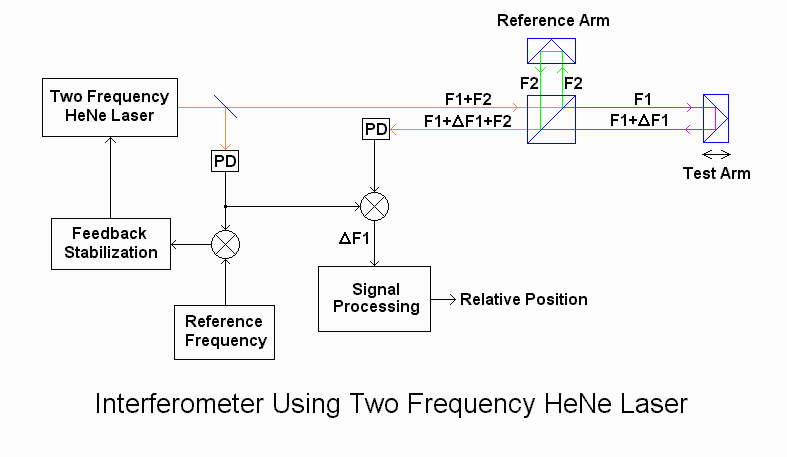
A diagram of the general approach is shown in
Interferometer Using Two Frequency HeNe Laser.
The two frequency laser consists of a HeNe laser tube surrounded by
permanent magnets which produce a constant axial magnetic field.
The laser tube is short enough that only a single longitudinal mode will
normally oscillate if it is near the center of the gain curve. (Those on
either side will not see enough gain.) The axial magnetic field results
in the Zeeman effect splitting the beam into two slightly different
frequencies which are circularly polarized in opposite directions. Thus,
instead of the laser output being a single line (wavelength), it becomes
a pair of lines at slightly different wavelengths which correspond to slightly
different frequencies. The difference between the two frequencies is
typically in the 1.5 to 4 MHz range which makes it extremely easy to
process electronically. The actual difference frequency is determined
by the strength of the magnetic field (and other physical details) as
well as how far away the (split) lasing mode is from the center of the
doppler broadened HeNe gain curve. The beat frequency is lowest when
the lasing mode is centered on the gain curve and increases the further
away from the center it is. At some point, the sub-mode furthest from the
center will cease to oscillate at all due to insufficient gain and the beat
will disappear. (If the tube is too long, more than one Zeeman split mode
may be present simultaneously resulting in a superposition of beat frequencies
which are not generally terribly useful.)
There is a piezo element and/or heater inside the laser tube to precisely
adjust cavity length. A feedback control system typically consisting
of a phase locked loop using a temperature stabilized quartz
oscillator as a reference is used to adjust the cavity length to
maintain the beat frequency at a specific point near the center of the
gain curve. The exact center would be optimum but might be difficult
to guarantee so it's probably slightly on one side. (Lower or upper
will depend on which one provides negative feedback stability.) For a
given tube/magnet combination, this sets the actual laser wavelengths
- and thus the measurement increment - to a very precise and constant
value which remains essentially unchanged for the life of the
instrument. For example, with the doppler broadened gain curve for
the HeNe laser being about 1.5 GHz FWHM (1 part in about 300,000 with
respect to the 474 THz optical frequency at 633 nm) and a 1 percent
accuracy within the gain curve, the absolute wavelength accuracy will
then be better than 1 part in 30 million! Not too shabby for what
is basically a very simple system. :)
Since the output of the laser is a beam consisting of a pair of
circularly polarized components, a wave plate is used to separate
these into two orthogonal linearly polarized waves, called F1 and F2.
The beam consisting of F1 and F2 is split into two parts: One part
goes through a polarizer at 45 degrees to F1 and F2 (to recover a
signal with both F1 and F2 linearly polarized in the same direction)
to a photodiode to generate a local copy of the reference frequency
for the laser stabilization feedback as well as the measurement
electronics; the second is the measurement beam which exits the laser.
The purpose of the remainder of the interferometer is essentially to
measure the path length change between two points. In a typical
installation, the beam consisting of F1 and F2 is sent through a
polarizing beam splitter. F1 goes to a corner (retro) reflector on
the object whose position is being measured and F2 goes to a corner
reflector fixed with respect to the beam splitter. However,
differential measurements could be made as well using F2 in some other
manner. Various "widgets" are available for making measurements of
rotary position, monitoring multi-axis machine tools, etc.
The return from the object corner reflector is F1+dF1 (delta-F1) which
is recombined with F2 and sent to a "receiver" module - a photodiode
and preamp which generates a new difference frequency, F1+dF1-F2.
This is mixed with the original F1-F2 reference to produce an output
which is then simply dF1. A change in the position of the object by
316 nm (1/2 the laser wavelength) results in dF1 going through a whole
cycle. By keeping track of the number of complete cycles of dF1 as
well as its phase, this provides measurements of object position down
to a resolution of a few nm with an accuracy of 0.02 ppm!
More information on the two frequency HeNe laser can be found in the
sections: Hewlett-Packard HeNe Lasers and
Two Frequency HeNe Lasers Based on Zeeman
Splitting. Searching on the Agilent Web site will yield some
more product specific information and application notes on two frequency
interferometers.
Your initial response might be: "Well, no system is ideal and the beams won't
really be perfectly planar so, perhaps the energy will appear around the
edges or this situation simply cannot exist - period". Sorry, this would be
incorrect. The behavior will still be true for the ideal case of perfect
non-diverging plane wave beams with perfect optics.
Perhaps, it is easier to think of this in terms of an RF or microwave, acoustic, or other source:
OK, I know the anticipation is unbearable at this point. The answer is that
the light is reflected back to the source (the laser) and the entire optical
path of the interferometer acts like a high-Q resonator in which the energy
can build up as a standing wave. Light energy is being pumped into the
resonator and has nowhere to go. In practice, unavoidable imperfections of
the entire system aside, the reflected light can result in laser instability
and possibly even damage to the laser itself. So, there is at least a chance
that such an experiment could lead to smoke!
(From: Art Kotz (alkotz@mmm.com).)
We don't have to to think all that hard to figure out where all the energy
is dissipated in a Michelson interferometer. Nor do we have to refer to
imperfect components either. The thought experiment of perfect non-absorbing
components still renders a physically correct solution.
To summarize a (correct) previous statement, in a Michelson interferometer
with flat surfaces, you can get a uniform dark transmissive exit beam. The
power is not dissipated as heat. There is an alternate path that light can
follow, and in this case, it exits the way it came in (reflected back out to
the light source).
In fact, with a good flat Fabry-Perot interferometer, you can actually
observe this (transmission and reflection from the interferometer alternate
as you scan mirror spacing).
In the electrical case, imagine a transmitter with the antenna improperly
sized so that most of the energy is not emitted. It is reflected back to the
output stage of the transmitter. If the transmitter can't handle dissipating
all that energy, then it will go up in smoke. Any Ham radio operators out
there should be familiar with this.
(From: Don Stauffer (stauffer@htc.honeywell.com).)
Many of the devices mentioned have been at least in part optical resonators.
It may be instructive to look at what happens in an acoustic resonator like an
organ pipe or a Helmholtz resonator.
Let's start with a source of sound inside a perfect, infinite Q resonator.
The energy density begins to build up with a value directly proportional to
time. So we can store, theoretically, an infinite amount of acoustic energy
within the resonator.
Of course, it is impossible to build an infinite Q resonator, but bear with me
a little longer. It is hard to get an audio sound source inside the resonator
without hurting the Q of the resonator. So lets cut a little hole in the
resonator so we can beam acoustic energy in. Guess what, even theoretically,
this hole prevents the resonator from being perfect. It WILL resonate.
No optical resonator can be perfect. Just like in nature there IS no
perfectly reflecting surface (FTIR is about the closest thing we have). Every
time an EM wave impinges on any real surface, energy is lost to heat. With
any source of light beamed at any surface, light will be turned into heat. In
fact, MOST of the energy is immediately turned to heat. By the laws of
thermodynamics, even that that is not converted instantaneously into heat, but
goes into some other form of energy, will eventually turn up as heat. You pay
now, or you pay later, but you always pay the entropy tax.
(From: Bill Vareka (billv@srsys.com).)
And, something else to ponder:
If you combine light in a beam splitter there is a unavoidable phase relation
between the light leaving one port and the light leaving the other.
So, if you have a perfect Mach-Zhender interferometer like the following
(From: A. Nowatzyk (agn@acm.org).)
A beam-splitter (say a half silvered mirror) is fundamentally a 4 port device.
Say you direct the laser at a 45 degree angle at an ideal, 50% transparent
mirror. Half of the light passes through straight, the rest is reflected at a
90 degree angle. However, the same would happen if you beam the light from
the other side, which is the other input port here. If you reverse the
direction of light (as long as you stay within the bounds of linear optics,
the direction of light can always be reversed), you will see that light
entering either output branch will come out 50/50 on the two input ports. An
optical beam-splitter is the same as a directional coupler in the RF or
microwave realm. Upon close inspection, you will find that the two beams of a
beam-splitter are actually 90deg. out of phase, just like in an 1:1
directional RF coupler.
In an experiment where you split a laser beam in two with one splitter and
then combine the two beams with another splitter, all light will either come
out from one of the two ports of the second splitter, depending on the
phase. It is called a Mach-Zehnder interferometer.
Ideal beam-splitters do not absorb any energy, whatever light enters will come
out one of the two output ports.
There will be interference but you won't see any visible patterns unless the
two sources are phase locked to each-other since even the tiny differences in
wavelength between supposedly identical lasers (HeNe, for example) translate
into beat frequencies of MHz or GHz!
(From: Charles Bloom (cbloom@caltech.edu).)
The short answer is yes.
Let's just do the math. For a wave-number k (2pi over wavelength), ordinary
interference from two point-like apertures goes like:
Now for different wavenumbers:
The L dependence is the usual phenomenon of "beats" which is also a type of
interference, but not the nice "fringes" we get with equal wavelengths (the L
dependence is like a Michelson-Morely experiment to compare wavelengths of
light, by varying L (the distance between the screen and the sources) I can
count the frequency of light and dark flashes to determine k-K.
So you would like to add a precision measurement system to that CNC machining
center you picked up at a garage sale or rewrite the servo tracks on all your
dead hard drives. :) If you have looked at Agilent's products - megabucks
(well 10s of K dollars at least), it isn't surprising that doing this may be
a bit of a challenge. As noted in the section:
Basics
of Interferometry and Interferometers, a high quality (and expensive)
frequency stabilized single mode HeNe laser is often used. For home use
without one of these, a short HeNe laser with a short random polarized tube
(e.g., 5 or 6 inches) will probably be better than a high power long one
because it's possible only 2 longitudinal modes will be active and they will
be orthogonally polarized with stable orientation fixed by the slight
birefringence in the mirror coatings. As the tube heats up, the polarization
will go back and forth between the two orientations but should remain constant
for a fair amount of time after the tube warms up and stabilizes. Also see
the section: Inexpensive Home-Built Frequency
or Intensity Stabilized HeNe Laser.
The problem with cheap laser diodes is that most have a coherence length that
is in the few mm range - not the several cm or meters needed for many
applications (but see the section: Can I Use
the Pickup from a CD Player or CDROM Drive for Interferometry?). There
may be exceptions (see the section:
Interferometers Using Inexpensive
Laser Diodes) and apparently the newer shorter wavelength (e.g., 640 to
650 nm) laser pointers are much better than the older ones but I don't know
that you can count on finding inexpensive long coherence length laser diodes.
Even if you find that a common laser diode has adequate beam quality when you
test it, the required stability with changes in temperature and use isn't
likely to be there.
The detectors, front-end electronics, and processing, needed for an
interferometer based measurement system are non-trivial but aren't likely to
be the major stumbling block both technically and with respect to cost. But
the laser, optics, and mounts could easily drive your cost way up. And,
while it may be possible to use that $10 HeNe laser tube, by the time you
get done stabilizing it, the effort and expense may be considerable.
Note that bits and pieces of commercial interferometric measurings systems
like those from HP do show up on eBay and other auction sites from time to
time as well as from laser surplus dealers. The average selling prices are
far below original list but complete guaranteed functional systems or rare.
(From: Randy Johnson (randyj@nwlink.com).)
I'm an amateur telescope maker and optician and interferometry is a technique
and method that can be used to quantify error in the quality of a wavefront.
The methods used vary but essentially the task becomes one of reflecting a
monochromatic light source, (one that is supplied from narrow spectral band
source i.e., laser light) off of, or transmitting the light through a reference
element, having the reference wavefront meet the wavefront from the test
element and then observing the interference pattern (fringes) that are formed.
Nice straight, unwavering fringe patterns indicate a matched surface quality,
curved patterns indicate a variation from the reference element. By plotting
the variation and feeding the plot into wavefront analysis software (i.e., E-Z
Fringe by Peter Ceravolo and Doug George), one can assign a wavefront rating
to the optic under test.
The simplest interference test would involve two similar optical surfaces in
contact with each other, shining a monocromatic light source off the two and
observing the faint fringe pattern that forms. This is known as a Newton
contact interferometer and the fringe pattern that forms is known as Newton's
rings or Newton's fringes, named for its discoverer, you guessed it, Sir Issac
Newton. If you would like to demonstrate the principle for yourself, try a
couple of pieces of ordinary plate glass in contact with each other, placed
under a fluorescent light. Though not perfectly monochromatic, if you observe
carefully you should be able to observe a fringe pattern.
Non-contact interferometry is much tougher as it involves the need to get a
concentrated amount of monochromatic light through or reflected off of the
reference, positioning it so it can be reflected off of the test piece, and
then positioning the eye or imaging device so that the fringe pattern can be
observed, all this while remaining perfectly still, for the slightest
vibration will render the fringe pattern useless.
(From: Bill Sloman (sloman@sci.kun.nl).)
An interferometer is a high precision and expensive beast ($50,000?). You use
a carefully stabilized mono-mode laser to launch a beam of light into a cavity
defined by a fixed beam splitter and a moving mirror. As the length of the
cavity changes, the round-trip length changes from an integral number of
wavelengths of light - giving you constructive interference and plenty of
light - to a half integral number of wavelengths - giving you destructive
interference and no light.
This fluctuation in your light output is the measured signal. Practical
systems produce two frequency-modulated outputs in quadrature, and let you
resolve the length of a cavity to about 10 nm while the length is changing at
a couple of meters per second. The precision is high enough that you have to
correct for the changes in speed of light in air caused by the changes
temperature and pressure in an air-conditioned laboratory.
Hewlett-Packard invented the modern interferometer. When I was last involved
with interferometers, Zygo was busy trying to grab a chunk of the market from
them with what looked liked a technically superior product. Both manufacturers
offered good applications literature.
(From: Mark Kinsler (kinsler@froggy.frognet.net).)
You can get interferometer kits from several scientific supply houses. They
are not theoretically difficult to build since they consist mostly of about
five mirrors and a lens or two. But it's not so easy to get them to work
right since they measure distances in terms of wavelengths of light, and
that's *real* sensitive. You can't just build one on a table and have it work
right. One possible source is: Central Scientific Company.
(From: Bill Wainwright (billmw@isomedia.com).)
Yes, you can build one on a table top. I have done it. I was told it could
not be done but tried it anyway. The info I read said you should have an
isolation table to get rid of vibrations I did not, and even used modeling
clay to hold the mirrors. The main problem I had was that the image was very
dark and I think I will use a beam splitter in place of one of the mirrors
next time. The setup I had was so sensitive that lightly placing your finger
on the table top would make the fringes just fly. To be accurate you need to
take into account barometric presure and humidity.
While I don't know how to select a laser diode to guarantee an adequate
coherence length, it certainly must be a single spatial (transverse) mode
type which is usually the case for lower power diodes but those above 50
to 100 mW are generally multimode. So, forget about trying to using a 1 W
laser diode of any wavelength for interferometry or holography. However,
single spatial mode doesn't guarantee that the diode operates with a single
longitudinal mode or has the needed stability for these applications. And,
any particular diode may operate with the desired mode structure only over
a range of current/output power and/or when maintained within a particular
temperature range.
(From: Steve Rogers (scrogers@pacbell.net).)
I have been involved with laser diodes for the last 15 years or so. My first
was a pulsed (only ones available at that time) monster that peaked 35 watts
at 2 kHz with 40 A pulses! It was a happy day when they could operate CW and
visible to say the least. Anyway, in the course of my working travels, I have
built numerous Twymann-Green double pass interferometers for the wave front
distortion analysis of laser rods, i.e., Nd:Yag, Ruby, Alexandrite, etc. The
standard reference light source for this instrument has always been the 632.8
nm HeNe laser. Good coherence length and relatively stable frequency was its
strong suit.
When visible diode lasers came out I often wondered aloud about their
suitability as a replacement for the HeNe. I despise HeNe lasers. They are
bulky and I have been shocked too many times from their power supplies.
I assumed that since CD player laser diodes at 780 nm could have coherence
lengths on the order of tens of centimeters or into the meters (!!, see, for
example: Katherine Creath, "Interferometric Investigation of a Diode Laser
Source", Applied Optics (24 1-May-1985) pp. 1291-1293), Visible Laser Diodes
(VLDs) could make excellent replacements. As it turned out, VLDs tend to have
coherence lengths which are considerably shorter according to the latest
technical literature and I held off on experimenting with them. Last week, I
went through my shop and found enough mirrors, beam splitter, assorted optics
to throw together my own double-pass interferometer for home use. This
coincided with my acquisition of a 635 nm 5 mw diode module - a good one from
Laserex.
To make a longer story shorter, I assembled said equipment with the VLD and
WOW! excellent fringe contrast (a test cavity of four inches using a .250" x
4.0" Nd:Yag rod as the test sample.) When a HeNe laser was substituted for
the VLD, virtually no difference in the manual calculation of wave front
distortion (WFD) and fringe curvature/fringe spacing. The only drawback with
the VLD is that it produces a rectangular output beam. When collimated you
have a LARGE rectangular beam rather than a nice round HeNe style beam. My
interferometer now occupies a space of 10" x 10" and is fully self contained.
It probably could even be made smaller. Not only that, but it runs on less
than 3 V!!!
I am just as surprised as you are with the results that I achieved. This is
one reason why it took me so long to attempt this experiment (something like
4 to 5 years). I have always assumed that a HeNe laser would be FAR superior
in this configuration than a VLD would be. Perhaps others may know more about
the physics than I do. One thing is certain, these are "single mode" index
guided laser diodes and typically exhibit the classic gaussian intensity
distribution which is not so evident with the "gain guided" diodes. This in
turn implies a predominant lasing mode which in turn would imply a (somewhat)
stable frequency output. Purists would note that this VLD has a nominal
wavelength of 635 nm +/- 10 nm while the HeNe laser is pretty much fixed at
632.8 nm. This variable could account for extremely minor WFD differences.
(From: W. Letendre (wjlservo@my-dejanews.com).)
There's an outfit in Israel selling a diode based laser interferometer enough
cheaper than Zeeman split HeNe units to suggest that they are using a laser
diode in the 'CD player' class, or perhaps a little better. They are able to
measure, 'single pass' (retro rather than plane mirror) over lengths of up to
about 0.5 m, suggesting that as an upper limit for coherence length.
People sometimes ask about using the focused laser beam for for scanning or
interferometry. This requires among other things convincing the logic in
the CD/DVD player or CD/DVDROM drive to turn the laser on and leave it on
despite the possible inability to focus, track, or read data. The alternative
is to remove the optical pickup entirely and drive it externally.
If you keep the pickup installed in the CD player (or other equipment),
what you want to do isn't going to be easy since the microcontroller will
probably abort operation and turn off the laser based on a failure of the
focus as well as inability to return valid data after some period of time.
However, you may be able to cheat:
CAUTION: Take care around the lens since the laser will be on even when there
is no disc in place and its beam is essentially invisible. See the section:
Diode Laser Safety before attempting to
power a naked CD player or simlar device.
It may be easier to just remove the pickup entirely and drive it directly. Of
course you need to provide a proper laser diode power supply to avoid damaging
it. See the chapter: Diode Laser Power
Supplies for details. You will then have to provide the focus and/or
tracking servo front-end electronics (if you need to process their signals or
drive their actuators) but these should not be that complex.
Some people have used intact CD player, CDROM, and other optical disc/k drive
pickup assemblies to construct short range interferometers. While they have
had some success, the 'instruments' constructed in this manner have proven
to be noisy and finicky. I suspect this is due more to the construction of
the optical block which doesn't usually take great care in suppressing stray
and unwanted reflections (which may not matter that much for the original
optical pickup application but can be very significant for interferometry)
rather than a fundamental limitation with the coherence length or other
properties of the diode laser light source itself as is generally assumed.
In any case, some of the components from the optical block of that dead CD/DVD
player may be useful even if you will be substituting a nice HeNe laser for
the original laser diode in your experiments. Although CD optics are optimized
for the IR wavelength (generally 780 nm), parts like lenses, diffraction
grating (if present and should you need it), and the photodiode array, will
work fine for visible light. However, the mirrors and beam splitter (if
present) may not be much better than pieces of clear glass! (DVDs lasers are
635 to 650 nm red, so the optics will be fine in any case.)
Unfortunately, everything in a modern pickup is quite small and may be a bit
a challenge to extract from the optical block should this be required since
they are usually glued in place.
If what you want is basic distance measurements, see the section:
Using a CD or DVD Optical Pickup for Distance
Measurements which discusses the use of the existing focusing mechanism
for this purpose - which could be a considerably simpler approach.
Also see the section: Basics of Interferometry
and Interferometers.
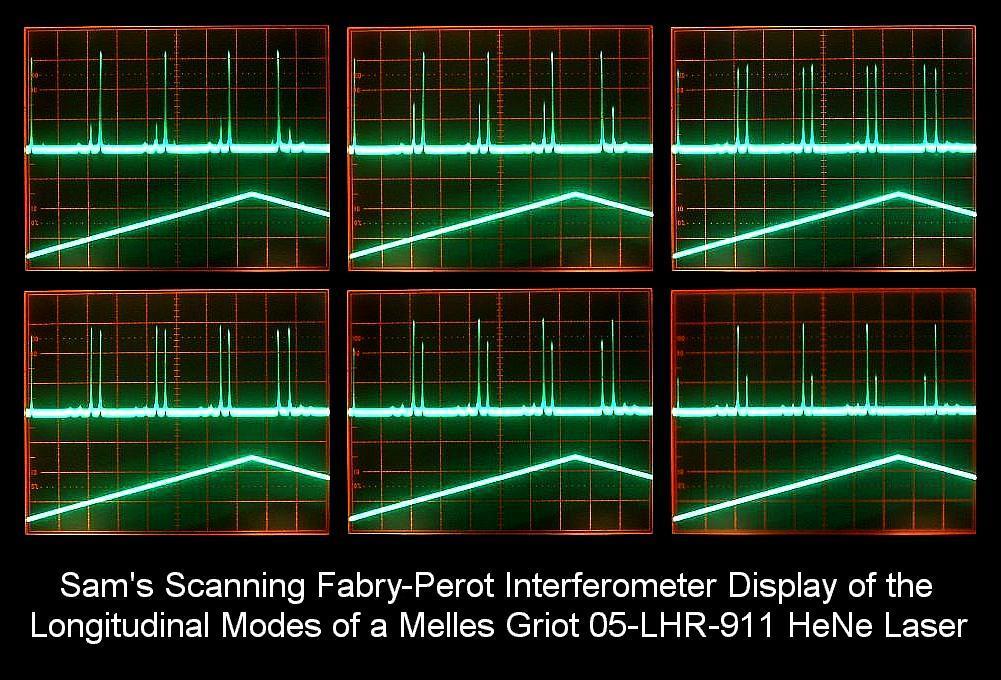
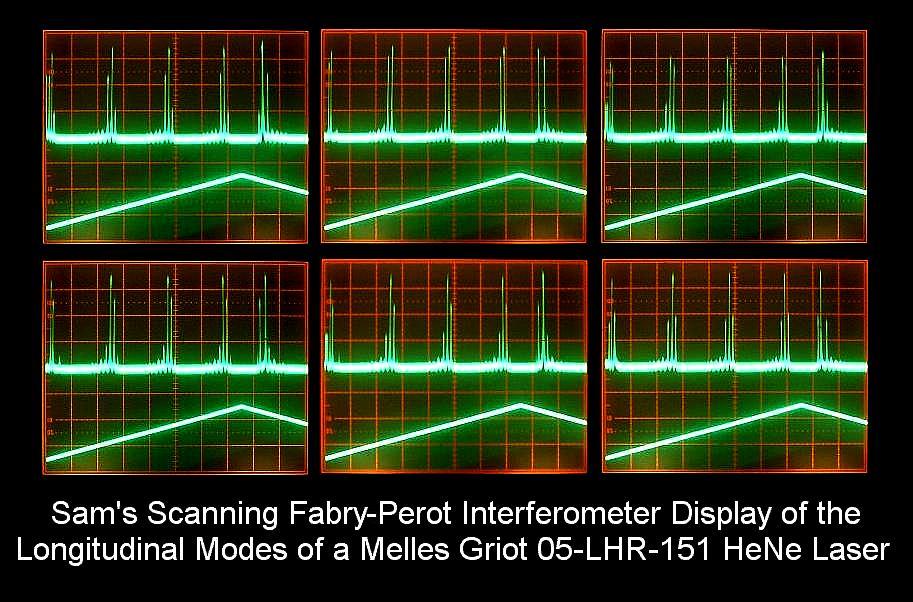
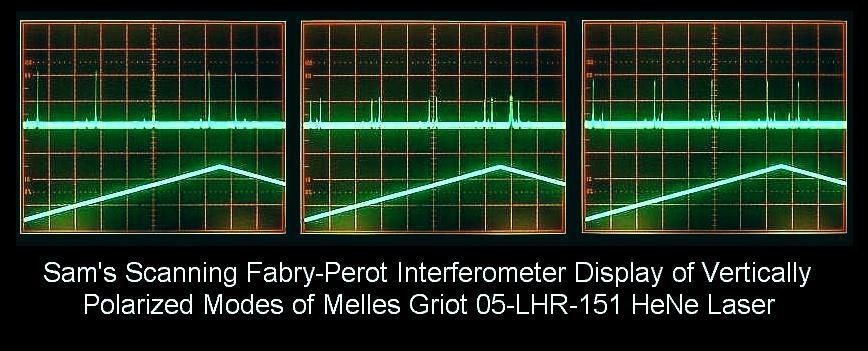
The longitudinal mode structure of a laser is one of those concepts
that is often explained but not so often demonstrated. There are
a number of indirect ways of showing that it exists including
monitoring the beat frequencies between modes and looking at
the fringe patterns in a Michelson or other conventional
interferometer. One of the clever ways of actually being able
to display the modes as they would appear in a textbook is to
use an instrument called a Scanning Fabry-Perot Interferometer
(SFPI). While conceptually simple, even a basic SFPI can
resolve detail in the longitudinal mode structure of a laser
that represents better than 1 part in 10,000,000 compared
to the frequency of oscillation of the laser.
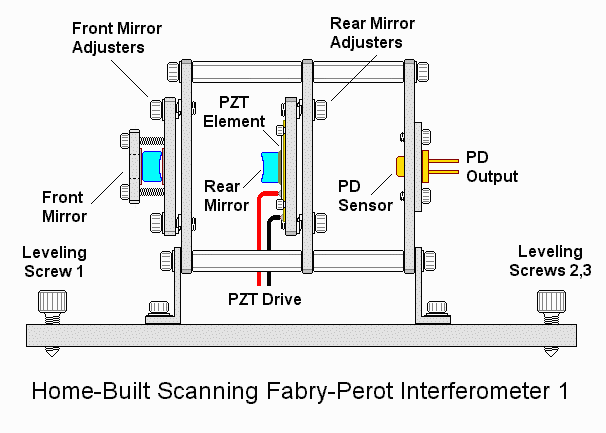
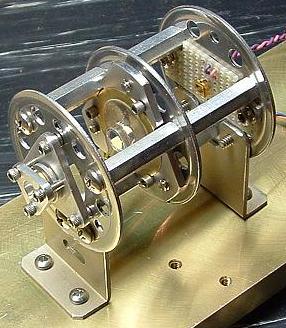
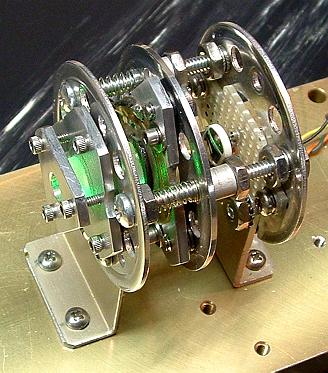
An SFPI consists of a pair of mirrors with relatively high
reflectivity (90% to 99.9% or more is typical) mounted
in a rigid frame. In most SFPIs, the laser under test (LUT) is
aimed into one end and a photosensor is mounted beyond the other end.
The coarse spacing and alignment of the mirrors can be adjusted by
micrometer screws. The axial position of one of the mirrors can also
be varied very slightly (order of a few half-wavelengths of the LUT)
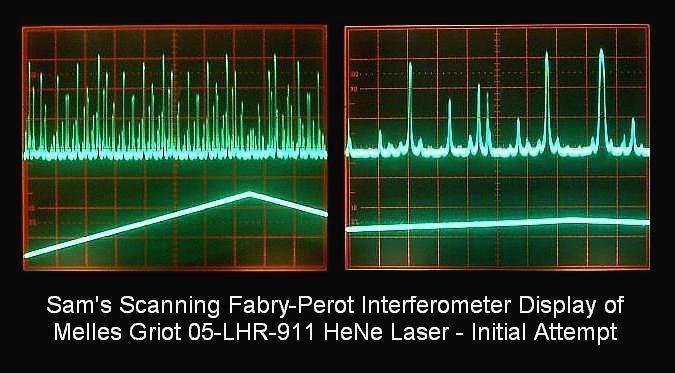
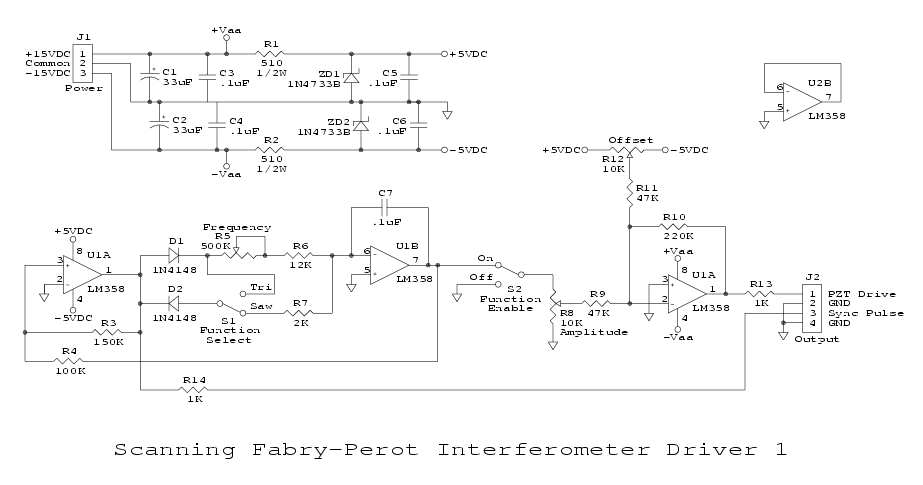
by a linear PieZo Transducer (PZT). By driving the PZT
with a ramp waveform and watching the response of the photosensor
on an oscilloscope, the longitudinal modes of the LUT can be displayed
in real time. In essence, the comb response of the SFPI is used
as a tunable filter (by the PZT) to analyze the fine detail of the
optical spectrum of the LUT. As long as the FSR (c/2*L except under
certain conditions, described below) of the SFPI is larger than the
extent of the lasing mode structure of the LUT, the mode display
will be unambiguous. Where this condition isn't satisfied, the mode
display will wrap around and may be very confusing. For example,
the common helium-neon (HeNe) laser has a gain bandwidth of about 1.5 GHz
and longer HeNe laser tubes will generally operate with multiple
longitudinal modes covering much of this range. Thus the
FSR of an SFPI to be used with such a laser must
be greater than 1.5 GHz, corresponding to an SFPI cavity length of
less than about 100 mm (assuming c/2*L). For Nd:YAG, the gain bandwidth
is about 150 GHz, which results in a required SFPI cavity length of
less than 1 mm! However, in practice, lasers don't necessarily lase
over their entire gain bandwidth, especially if specific steps have
been taken to assure single or dual mode operation (also called single
or dual frequency operation). For those - which include many useful
lasers - the requirement can be relaxed such that the FSR of the SFPI
only needs to be larger than the width of the expected mode structure.
And for a single mode laser, this would be only the width of the lasing
line itself. Therefore, in these cases, a long cavity low FSR SFPI will
result in the highest resolution.
Commercial scanning Fabry-Perot interferometers usually cost thousands
of dollars - or more! But it's possible to construct an SFPI that
demonstrates the basic principles - and can be even quite useful -
for next to nothing, and one that rivals commercial instruments for
less than $100.
The resolution ("resolvence") of a Fabry-Perot interferometer is determined
by the wavelength, mirror reflectance, mirror spacing, and incidence angle
of the input beam. For the following, we assume normal incidence (which
will be satisfied in most practical situations).
Consider an SFPI with a mirror spacing (d) of 80 mm and reflectance (R) of
99 percent at a wavelength (Lambda) of 632.8 nm (red HeNe laser):
Another measure of the performance of an interferometer or laser cavity
is the "finesse". This dimensionless quantity is the ratio of the
FSR to the resolution. In essence, for the SFPI, finesse determines the
how much fine detail is possible within one FSR. The reflectance finesse
is equal to pi*sqrt(R)/(1-R) where R is the reflectance of each mirror (which
are assumed to be equal). For R near 1 as would be the
case in a useful SFPI, this reduces to pi/(1-R). While other factors
will affect the finesse, this equation will be reasonably accurate for
a properly designed spherical mirror cavity. So, with a reflectivity of
99 percent for both mirrors, the finesse will be roughly 300. If the
FSR is 1.875 GHz as in the example above, the resolution will be
approximately 6 MHz, which is in agreement with that calculation.
Other factors will conspire to reduce the useful resolution of a practical
SFPI. At modestly high mirror reflectivity (e.g., R=99%), these include
alignment, input beam diameter, and input beam collimation. As R is pushed
closer to 100%, the quality of the mirrors, their cleanliness, and internal
losses become increasingly important. But for the example above, even if
the actual finesse is worse by an order of magnitude compared to the theory,
it will still be possible to easily resolve the individual modes of any
common HeNe laser and probably even the nearly 2 meter long Spectra-Physics
model 125 (177 cm resonator, mode spacing of 85 MHz). This is a factor of
better than 1 part in 10,000,000 comparing resolution to optical frequency!
However, note that while textbooks will tell you that the peaks should get
through with little attenuation, this is probably not going to be true with
practical high finesse SFPIs. (At least not those you're likely to see!)
The amplitude of the peaks will depend critically on the quality of the
mirrors and of course, on the alignment. For "laser quality" dielectric
mirrors, I've gotten as high as 5 to 10 percent peak transmission for a
high finesse SFPI using mirrors with a reflectivity of 99.8%. I'm sure
this can be improved upon but even so, for a 1 mW laser, there is still
more than enough optical power at the output of the SFPI to produce a
nice display on most scopes using a 1:1 probe without a preamp.
(From: A. E. Siegman (siegman@stanford.edu).)
In evaluating the effect of losses in Fabry-Perot mirrors you really
have to distinguish between internal losses (or loss-equivalent effects,
like scattering) that are physically located "inside" the mirrors (i.e.,
inside the effective reflection plane of each end mirror), and external
losses that are physically located "outside" the effective reflection
plane, but still within the physical layer of the mirror.
Losses that are outside the mirrors are effectively just additional
external transfer losses in the system, i.e. they have the same effect
as if they were separate from the FP, so that they don't affect the FP
itself but just weaken the light before or after the FP.
Losses inside the mirrors (aka "internal" losses) are more serious
because they are exposed to the higher-intensity resonant fields inside
the FP and therefore can significantly affect the finesse and peak
transmission of the FP.
Just measuring the net reflectivity and net transmission of the mirror
itself won't clearly distinguish between these internal and external
losses. Also, how you'd describe a situation where the losses are
distributed through a moderately thick mirror layer is something I've
never thought through; doing this would require a slightly more
sophisticated wave calculation of forward and backwave wave propagation
inside the finite-thickness partially absorbing mirror layer itself.
(Too bad I'm no longer actively teaching laser courses; this
calculation would make a nice homework problem to torment -- sorry,
educate -- students.)
One way to eliminate the transverse mode problem is to use a cavity
configuration called a Mode Degenerate Interferometer (MDI) in which the
higher order transverse modes have the same frequency/wavelength as some
of the TEM00 (longitudinal) modes and thus simply fall on top of them
in the display. Even though each peak in the display representing a
longitudinal mode of the input laser may actually be
built up of contributions from multiple transverse modes excited in
the resonator of the interferometer, the characteristics
of the individual longitudinal mode components in each of these
transverse mode are the same so the accuracy of the resulting display
isn't affected. (This should not be confused with the very different
situation of a laser having multiple transverse modes in
its output where the frequencies, phases, amplitudes, and
polarizations of the corresponding longitudinal modes in each
transverse mode may differ.)
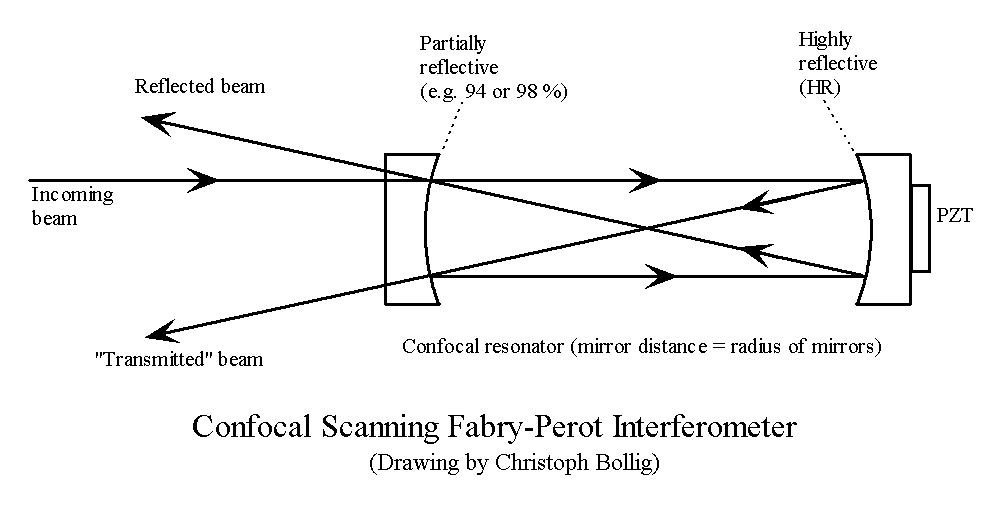
Two practical arrangements that satisfy this condition are the (1)
spherical cavity (d=2*r) and (2) confocal cavity (d=r). The confocal
cavity has the larger finesse and is thus usually employed in SFPIs
since the finesse is a measure of Q-factor with respect to the FSR
or mode spacing, and thus higher finesse results in better resolution.
A planar cavity (r is infinity) doesn't support higher order modes at all
but is generally a less desirable configuration (see below).
Note that the term "confocal" actually refers to any cavity where the
focal points of the two mirrors are coincident. However, only the case
where d=r is stable and thus useful for the MDI SFPI.
The frequencies of the transverse modes of a symmetric cavity
Fabry-Perot resonator are given by the following equation:
where:
The interferometer will be mode degenerate when there are TEM00 modes that
have the same frequency as some of the transverse modes. The
requirement for this to be satisfied is for the inverse cosine term
in the equation above to be equal to pi divided by an integer, l. Then
there will be "l" types of modes with one type - where (1+m+n) is equal to
1, modulo(l) - having the same frequencies as some TEM00 modes.
When (1+m+n) is not equal to 1, modulo(l), that mode will fall
in between the TEM00 modes in locations depending on (m+n)/l, modulo(l):
While the confocal and spherical MDI configurations are the best known
and most widely used, it's possible to make use of cavities having values
of l other than 1 or 2 and they may be useful for certain applications.
See: Variable
Free Spectral Range Spherical Mirror Fabry-Perot Interferometer. Though
that's for the advanced course, here are a couple of examples:
Further investigation of these special cases is left as an exercise
for the reader. :)
For the confocal cavity, half of the transverse modes are not
mode degenerate when an on-axis input beam is used as
there are two types of modes depending on whether the quantity
(1+m+n) is even or odd:
This seems a bit strange that the TEM00 modes (m+n=0) have non-integer mode
numbers but the equation has been confirmed from at least two different
sources.
As noted, with two sets of peaks, the FSR is effectively cut
in half to c/(4*d). Rearranging the equation above with the new FSR of c/(4*d)
out in front, one sees that the various transverse modes (those that
differ in m+n) result in a frequency difference of c/(4*d). However,
integer differences in q corresponding to the longitudinal modes, still
have an FSR of c/(2*d). Where a paraxial beam (one parallel to the
optical axis) enters the confocal cavity off-center, the beam path repeats
itself after two traversals of the cavity (in a zigzag pattern) and the
FSR is easily seen to be c/(4*d) rather than c/(2*d). However, if the
beam is very well aligned and centered, the FSR will be c/(2*d) since only
some symmetric modes will be excited.
Note that when adjusting the mirror distance to be confocal, there will be
many positions where the SFPI may appear to work but which aren't quite
confocal. Depending on the specific distance, non-degenerate higher order
modes will result in ghost peaks and/or a variation in the amplitude of
the lasing modes depending on their position on the voltage ramp drive
signal. The amplitude will also be lower overall. However, when the
correct distance is approached, all of these ghosts will collapse into
the desired high amplitude display. Don't be fooled! Thus it's best to
know or determine the exact RoC for the mirrors before installing them in
the SFPI so the initial distance can be set reasonably precisely.
Planar mirrors may also be used since a true flat-flat cavity does not
support stable higher order modes, degenerate or otherwise, but it is
the most difficult to align and
the realizable finesse is lower than for the confocal arrrangement. The
"effective fineese" is also much more dependant on the alignment than
with the MDI or with other non-planar configurations. Also, with optimal
alignment, the incident beam is reflected directly back into the laser
which may result in instability for some types of lasers. However, where
the distance between the mirrors of the SFPI is adjustable (as in some
general purpose instruments like the TecOptics FPI-25), there is no
choice. (Intracavity etalons also usually use planar mirrors but the
finesse of these does not generally need to be very high.)
My challenge was to prove that I could construct an SFPI that would
at least demonstrate the basic principles and possibly even be useful.
The results are described in this and the following sections.
All of mine cost me absolutely nothing (except time) but
that wouldn't sound as credible as $1.00 or $2.00 or $3.00. :)
The heart of the SFPI is its two mirrors. For longer visible
wavelengths (i.e., 600 to 700 nm), the mirrors can be the OCs salvaged from a
pair of dead red (632.8 nm) HeNe laser tubes. For other wavelength ranges,
mirrors from green (532 nm) DPSS lasers, green or blue ion lasers, HeCd, and
other lasers may be useful. While some of these mirrors may have a relatively
broad band reflectance, this cannot be counted on. More often than not,
the reflectance falls off dramatically beyond 10 or 20 nm from the spec'd
wavelength. And, obtaining proper single mode performance
of the SFPI without great pain may require that mirrors with specific
reflectances and RoCs not normally found in common lasers be used.
Of course (gasp!), suitable mirrors can be also be purchased.
For common wavelengths, they may be available from companies like CASIX at
very reasonable prices. But in general, obtaining the optimum mirror might
require ordering a set of custom mirrors. It's not the ground and polished
mirror glass itself that will cost a lot of money. They can often be
standard concave lenses with suitable curvature available from places
like Edmund Industrial Optics or Melles Griot. It's the custom coating,
which can easily exceed $1,000, and it doesn't matter that much whether
the lot is 2 mirrors or 200 mirrors as what counts is the coating machine
time. So, find 99 friends who want to build the same SFPI and the
per-mirror cost could still be quite low. :)
As far as attempting to coat your own mirrors - in two words: Forget it. :)
Unless you have access to a dielectric mirror coating machine and know how
to use it (and are permitted to use it!), there is no way to produce coatings
that will do anything more than provide a hint of what's possible. Metal
(aluminum, silver, gold) coated mirrors do not work well since their maximum
reflection coefficient is around 94 to 97 percent and they have high
absorption losses. Thus finesse will be poor and the photodetector
signal will be very small. And except for gold, the coatings degrade
(tarnish, oxidize) in air without a protective layer, with silver being
the worst. For good quality dielectric mirrors, absorption losses only
become a major concern for very high reflectivities (perhaps above 99.9%)
and modern coatings do not degrade significantly under normal conditions
as long as they are not subject to physical abuse or improper cleaning
techniques.
When specifying the mirror RoC (r) for a particular application, it
usually makes sense to base it on the maximum frequency range over
which there will be action, not simply on the gain bandwidth of the
laser(s) being observed. Not only will this result in the best
resolution, but doing otherwise may simply not be practical.
For common gas lasers like the HeNe and argon ion which
have longitudinal modes filling most of their gain bandwidth,
(1.5 GHz and 5 GHz, respectively) there's no choice if the
display is to be unambiguous. But where the modes have already
been limited by an etalon or some other means, only the range
of the modes that are present need to fit into the SFPI's FSR.
For example:
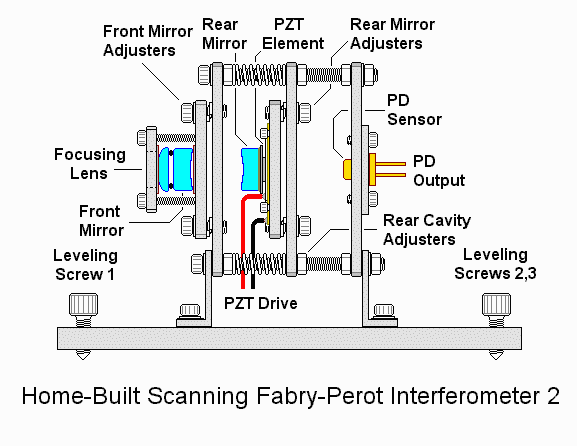
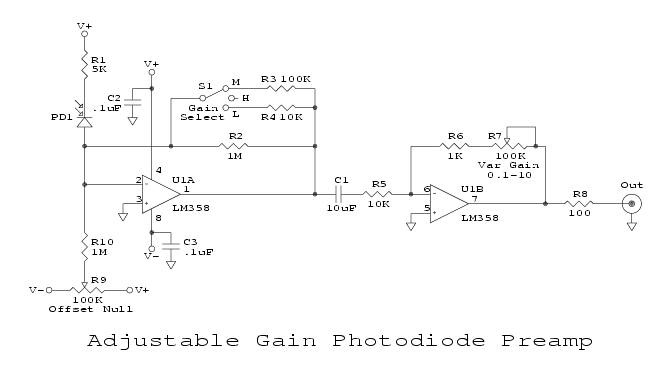
The other major components of the SFPI include the PieZo Transducer (PZT) to
move one of the mirrors a micron or so, and a photodiode to monitor the
output beam.
High quality PZTs can be purchased at exorbitant cost. But the beeper from
a digital watch or similar device will work nearly as well and has the
advantage that it runs on much lower voltage than some other types. You
never did like that alarm anyhow. :) But no need to discombobulate your
watch as these piezo elements can be purchased from electronics distributors
or surplus places for about $1.00. :) While they aren't quite as linear or
have as good a frequency response as the high priced units, these deficiencies
don't really matter much for an SFPI. And since they will move several microns
on only 50 V, a high voltage amplifier isn't needed as with many commercial
SFPIs. The 20 or 30 V p-p output of a typical function generator is quite
adequate.
.
The photodiode can be almost anything since it needs neither a large area or
high frequency response. I typically use a photodiode from a barcode
scanner with a 10K ohm resistor load and 10:1 or 1:1 scope probe. Where
more sensitivity is needed as with very high-R mirrors or low power lasers,
a transimpedance amplifier with very high gain using can be added since
frequency response isn't critical. Any garbage op-amp will suffice.
Everything else is hardware. The structure and mirror mounts are easily
home-built. However, one area where it may be hard to compete with
commercial SFPIs is in minimizing the effects of temperature. They typically
construct the main support as a cylinder or set of rods made from Invar,
a low coefficient of thermal expansion alloy. Some designs further
compensate for residual effects by balancing them against those
of the PZT resulting a near zero net change in FSR with respect
to temperature and/or may include a heater in a closed-loop temperature
stablization system. Invar stock is available or can be salvaged from
various dead lasers. Some people build SFPIs by mounting the back mirror
and PZT in an Invar tube, positioning the front mirror using a 5-axis
lab stage, and then gluing it in place permanently when the optimal
mirror spacing and alignment has been determined. But glue tends to be
too permanent for my taste. :) Constructing the SFPI using Invar rods
is nearly as good. But simply enclosing a non-Invar based SFPI in an
insulating box will go a long way in reducing temperature effects.
A triangle (or sawtooth) wave source (it can be a simple circuit constructed
for this purpose or a general purpose function generator) and oscilloscope
(preferably dual trace and/or with an X-Y display mode) will be required to
view the scan but needn't be dedicated to the SFPI, so they don't count
toward the cost!
The next few sections include general descriptions and photos of several
home-built SFPIs. Schematics for both a photodiode preamp and simple
function generator are provided later in this chapter.
The basic design is shown in Home-Built Scanning
Fabry-Perot Interferometer 1. My prototype uses the OC mirrors from
a couple of dead Aerotech 1 mW HeNe laser tubes. The PZT is the beeper
from some sort of musical greeting card with a 4 mm hole drilled in the
center. The photodiode is from a barcode scanner.
The frame and mounts are a bit different than those shown in the
diagram, above. They were made from the platter clamping plates from some
ancient 5-1/4" harddrives, hex spacers, and miscellaneous scrap metal.
The circular plates are nice because they have predrilled holes with
6-fold symmetry thus simplifying construction. See
Photo of Sam's $1.00 Scanning Fabry-Perot
Interferometer. Here is a summary:
The front mirror is removable so other reflectances or RoCs can be tried. The
rear mirror is glued to the PZT. The hole was made by placing the PZT
on a hard surface (e.g., an aluminum plate) and drilling through it slowly
with modest pressure using a normal metal bit in a drill press. The piezo
material is more of a compressed powder than a true ceramic so it's possible
to grind it away (using the metal drill) with minimal chipping. Thin flexible
wires were already attached but if they aren't, solder the top lead near the
edge to leave room for the mirror and to minimize any change in elasticity of
the top surface. Once soldered, Secure the wires mechanically with a drop of
adhesive. Also note that the metallization tends to disappear with even
modest heat or stress so solder quickly. Conductive paint or silver Epoxy
can be used to touch up bare spots if needed but use as thin a layer as
possible as it may increase stiffness and reduce response sensitivity in
that area. For this reason, DO NOT coat the entire surface with adhesive
of any type!
To perform initial alignment, I used a yellow-orange HeNe laser thinking it
would be easier since the mirrors are less reflective away from the
632.8 nm design wavelength. The scatter off of the mirror surfaces was used
as the initial means of setting alignment, by minimizing the size of the line
or blob formed by the multiple reflections. With a pair of concave mirrors,
not only do they have to be aligned with respect to the input beam, they also
have to be aligned with respect to each other. In other words, their optical
axes must coincide which requires walking them until the scatter pattern is
minimized. When misaligned, it will be a line or circle and no amount of
adjustment of only one mirror may improve it. Once the initial alignment
was done, the PZT could be driven and the output of the photodiode used to
fine tune it. In retrospect, using the funny color HeNe laser wasn't
necessary as enough red light gets through to be easily seen for alignment
purposes. And the display of the modes of that multi-wavelength and
multi-transverse mode laser was definitely strange.
The preliminary results using a Melles Griot 05-LHR-911 HeNe laser were
also confusing. This is a 2 mW laser using a tube with about 165 mm between
mirrors, corresponding to a mode spacing of 883 MHz. The scope trace in
Sam's SFPI Display of Melles Griot 05-LHR-911 HeNe
Laser - Initial Attempt shows a jumbled mess due to many transverse modes
being excited in the SFPI. The trace on the left should cover a span of
approximately three FSRs of the SFPI - about 19.5 GHz. Three clumps that look
about the same are clearly visible but the complexity isn't real. The trace
on the right is an expanded region of the one on the left. A hint of the
modes of the laser can be seen but only a hint. The 05-LHR-911 should have
2 or 3 longitudinal modes at most but the short cavity of the SFPI using
long radius mirrors is resonating with multiple transverse modes.
There is also some hysteresis in the PZT response. It's barely visible
on the display as the pattern differs slightly on the positive and negative
slopes of the triangle driving function. Using X-Y mode on the scope would
show up the hysteresis more clearly. Reducing the sweep speed slightly
virtually eliminates the hysteresis. (A 20 trace/second display has
minimal hysteresis and is still quite usable. Of course, this wouldn't
be an issue with a digital scope
The overall linearity of the PZT is around 5 to 10 percent over a range of
+/-20 V, corresponding to 5 or 6 FSRs of the SFPI. I've actually tested
several PZTs (another one was from a digital clock for which the alarm was more
of a nuisance than useful!). The response of one is compressed more toward
the upper end of the voltage range; the other is slightly compressed at both
ends. Within a single FSR, the linearity is probably better than 2 percent
and a range of a single FSR provides all the information usually needed.
For a system of this type where qualitative information is most important,
perfect linearity, especially over multiple FSRs, really isn't a major issue
in any case as long as it is known and doesn't change over time. A third
PZT was quite linear but had a range of only around 1 FSR of the SFPI -
probably due to the excessively thick layer of silver Epoxy I used to cover
some bald spots on the piezo disk.
To confirm that transverse modes were the cause of the complex display and to
partially remedy the situation, I aligned the SFPI more carefully by adjusting
the front mirror so that the 05-LHR-911 beam bounced directly back to the
source with dancing interference patterns, then aligned the rear mirror
for maximum amplitude of the displayed signal, and added an aperture about
0.3 mm in diameter (a pin hole in a piece of aluminum foil) inside the SFPI
cavity. The aperture was mounted on a micropositioner but could be installed
permanently so that doesn't blow my budget. :) The results are shown
in Sam's SFPI Display of Melles Griot 05-LHR-911 HeNe
Laser. The sequence of the six traces
show the modes of the 05-LHR-911 cycling over time as they
move under the HeNe gain curve. The horizontal scale is the same as
in the jumbled mess trace, above, but the transverse modes have been
almost entirely eliminated. The distance between similar peaks (2.2 boxes
on the screen) is the FSR of the SFPI - about 6.5 GHz. The distance
between longitudinal modes (0.3 boxes) is the 883 MHz FSR of the 05-LHR-911.
The math even works. :) So, this represents success of sorts
but alignment of everything is super critical and any vibrations - even
the audio from a radio - create havoc with the display. There is also
a quasi-periodic fluctuation in amplitude of all the displayed modes with
no corresponding power fluctuations in the laser. I suspect this to be
due to residual mode competition in the SFPI as the frequency of the modes
changes relative to the SFPI cavity, possibly a side effect of the aperture.
Sam's SFPI Display of a Melles Griot 05-LHR-151 HeNe
Laser shows the result using the same setup for a longer laser with more
closely spaced modes - 436 MHz compared to 833 MHz for the 05-LHR-911. With
this higher power laser, there are still some non-TEM00 modes just visible in
the display but they are fairly low level.
Sam's SFPI Display of Vertically Polarized Modes
of Melles Griot 05-LHR-151 HeNe Laser shows the effect of inserting
a polarizing filter into the beam. Since adjacent modes tend to be
of orthogonal polarization in randomly polarized HeNe lasers, every other
mode on the display has disappeared.
Finally, I tried a Spectra-Physics model 117A HeNe laser head, which when
used with its mating controller is a frequency or intensity stabilized
(single longitudinal mode) laser. I'm running it on an SP-248 so it's
not stabilized but the modes are a bit interesting. The mode spacing is
around 600 MHz which is consistent with a 2 to 3 mW HeNe laser. However,
as the modes cycle, there isn't a smooth progression through the gain
curve. It almost seems as though having exactly 2 modes is enhanced somehow
and that it's very unlikely to see 1 or 3 modes. When 1 or 3 modes would be
expected to pop up, they might appear very briefly, or be skipped
entirely in favor of the 2 modes one of which is on the opposite
side of the gain curve. The polarizations of the modes also appear to
be of the "flipper" variety, changing suddenly rather than staying with
a particular mode. I don't know if this behavior is by design. However,
since orthogonally polarized modes are sensed by a pair of photodiodes
in the laser head and used for stabilization, strong mode pairs could be
beneficial.
After determining experimentally that an aperture helped but didn't
totally eliminate the transverse mode problem, a Post Doc in our lab wrote
a simple Matlab program to calculate Hermite Gaussian transverse mode
profiles given the mirror RoCs and the distance between mirrors. Plugging
in the long radius SFPI cavity configuration revealed that the TEM00 and
TEM10/01/11 modes have a high degree of overlap regardless of axial position.
So, any aperture that suppresses them very effectively would also result in
unacceptable attenuation of the TEM00 mode. So, on to plan B. :)
I hope to have a compiled version of this program available in the near
future as it appears to be quite useful for visualizing cavity modes in
general.
Here is a summary of the configurations I've tried so far on the $1.00
SFPI:
Of these, the first is probably the best choice unless super high resolution
is needed. All except the flat-flat required an aperture inside the SFPI
cavity to suppress non-TEM00 (transverse) modes.
The mirrors were actually Melles Griot plano concave lenses custom
coated (along with a batch of microchip laser crystals) for 1,540 nm.
Now, it's perhaps a not so well known fact that a dielectric mirror
coated for a wavelength of X nm will also perform reasonably
well at a wavelength around X/3 nm (think of a stack of 3/4 lambda layers
instead of 1/4 lambda layers). The actual reflectance function will depend
on the design of the original mirror (number of layers, uniformity of
layer thickness, etc.) and will likely be slightly lower in maximum
reflectance, but possibly not by much. So, these mirrors should work
in a wavelength range centered around 513 nm (1,540/3).
I had two types available: Those that were supposed to be 98 percent
as OC mirrors and those that were supposed to be HR mirrors, both at 1,540 nm.
Here are how they performed at the two green wavelengths of interest:
For 532 nm, neither is really ideal. The "OC" is a bit low - I would have
preferred around 99% to achieve a higher finesse. However, 97.8% is still
decent. The reflectance of the "HR" - which could be even higher than the
measured 99.8% since the 0.02% transmission measurement was not very accurate
- might be too high to get a decent signal but could result in a very high
finesse. But at 543.5 nm, the "HR" mirror seems to be perfect.
The only thing not wonderful about these mirrors is that the planar side
isn't AR coated. (Since they were intended only for some tests, we
saved money by not having AR coating!) But, if they are slightly
tilted, hopefully, this won't be a major problem.
There are also several radii to choose from. For the first version, I
used the longest RoC which is a Melles Griot 01-LPK-01. This is a 10 mm
diameter BK7 lens with a focal length of -20 mm which has a RoC of
about 10.3 mm. (For BK7, the RoC of a plano-concave lens is -0.517 of
the focal length.) This results in an FSR of about 7.8 GHz. Note that
the FSR is c/(4*d) for the confocal cavity, one half that of the long radius
or planar SFPI cavities. See the previous section. So, these will be good
for all green HeNe lasers and longer cavity single mode green DPSS lasers
like the C315M and C532, as well as that Far East disaster described in the
section: Reconstruction of an 80 mW Green DPSSFD
Laser. However, short cavity DPSS lasers including green laser pointers,
the Uniphase uGreens, MCA based DPSS lasers, and possibly the Transverse
TIM622 will require a shorter SFPI cavity. The other sets of mirrors go
down to around a 5 mm RoC so another version may be built with a set of these.
However, note that since the gain bandwidth of Nd:YAG and Nd:YVO4
is over 150 GHz and the SHG green conversion also doubles the frequency
between modes, multimode solid state lasers may have frequencies which
greatly exceed the FSR of any of these medium length SFPI cavities.
Unambiguous display of their modes may require an SFPI with an FSR of more
than 300 GHz - a cavity length of 0.25 mm for the confocal configuration!
This is not very practical. Fortunately, what's oftem most important is
to confirm single or maybe dual longitudinal mode performance so a much
smaller FSR is adequate and desirable for maximum resolvance.
The mechanical configuration is similar to the $1.00 SFPI except that the
rear mirror mount can be moved along the optical axis on threaded rods
to match the mirror distance to the RoC of the mirrors. A diagram
along the lines of the simple design of the $1.00 SFPI is shown in
Home-Built Scanning Fabry-Perot Interferometer 2.
Again, mine was constructed of cast off disk drive parts and other
miscellaneous junk. :) The first photodiode I used for this SFPI
was a $2.00 part from Digikey - which would have been my total cost if it
hadn't already been in one of my random stuff drawers. :) And, the
frame is a bit shorter since the RoC of all of these mirrors is so small.
Please see: Photo of Sam's $2.00 Scanning Fabry-Perot
Interferometer.
For the initial test, I am using the HR mirror set with an 05-LGR-151 green
HeNe laser head. Since this is a less than 0.5 mW output laser and the
sensitivity of silicon photodiodes at 543.5 nm is somewhat lower than
at 632.8 nm, detection is more difficult.
Furthermore, in order for the SFPI to be mode degenerate, the mirror spacing
really has to be quite close to the RoC for the confocal configuration.
Since these were originally lenses and not mirrors, the exact RoC is not
really known. OK, the real story is that I didn't locate the part
numbers of the lenses until after I did the initial construction and
wrote this paragraph! There are many ways to determine the actual RoC of the
mirrors. A collimated beam can be reflected from the mirror at a slight
angle. The focal point will be at a distance of one half the RoC.
Alternatively, a point source like a bare visible laser diode can be
imaged back onto itself from the mirror. Then, the RoC is the distance
to the mirror. However, any such measured RoC is only approximate. For
the SFPI to be mode degenerate, it needs to be quite precise and this can
only be determined experimentally.
The mirror alignment itself isn't super critical. It's best to have a way
of changing mirror distance without affecting alignment very much but simple
three-screws adjusters work just fine. The laser used for the alignment
should have a known spectrum if possible, preferably a single longitudinal
mode. As the correct distance is approached, the little peaks from all
the modes of the not quite confocal cavity - which may indeed be very small
or undetectable - will gradually merge into one peak whose amplitude will
increase and width will decrease dramatically.
Note that the MDI doesn't eliminate higher order transverse modes. It
only assures that many of them will have the same frequency
as the TEM00 modes. If the distance between the mirrors isn't close to
the RoC, there will be higher order modes at essentially random frequencies
relative to the TEM00 modes. The result will be very low fringe contrast
in the output as the PZT voltage is varied. However, as the correct distance
is approached, these will approach the TEM00 modes. Visually, if the
distance between the mirrors is moved slowly with the PZT around the
optimal distance, the output beam from from the SFPI (going to the
photodiode) will flash on and off uniformly across its entire width,
while on either side there will be concentric rings of light and dark
sweeping from center to edge or vice-versa.
It's actually quite remarkable that varying the PZT voltage by hand
(ramp turned off), the output of the SFPI can be tuned to all light or
all dark very precisely when the distance is just right. Indeed, only
the TEM00 mode remains! In addition, alignment of the SFPI relative to
the laser is very easy. The reference I am using is to adjust the
the reflection from the planar surface of the front mirror to be
just below the output aperture of the laser, then adjust the position
of the beam (without changing its angle) to center the reflected blob
from the curved rear surface of the front mirror.
At this point, after some fiddling, I am able to see the modes of the
05-LGR-151, though the signal is extremely low level and the finesse
is poor. In addition, the modes appear to be somewhat distorted - possibly
due to the distance between the mirrors not being quite correct. Switching
the function generator to DC output mode and adjusting the voltage
through the modes of the HeNe laser shows a very complex transverse
mode pattern which is clearly not degenerate even when the mirror distance
is very close to optimal. I don't know if this is due to the distance
still not being perfect (commercial SFPIs are set to within a few um)
or due to poor accuracy in the spherical shape of the mirrors.
Focusing the beam improves the resolution and amplitude of the signal
somewhat or just due to the nonuniformity of the coating which results
in the reflectance decreasing from center to edge. A modest size aperture
(perhaps 1 mm) will probably help to eliminate many of the higher order
mode since they are quite spread out.
Up to this point, my conclusions were mixed. Yes, the jumbled peaks were
gone. And, alignment is definitely much less critical - once the distance of
r is found, any two of the three rear mirror mount nuts or mirror adjusters
can easily peak the output in no time flat. But, the resolution is
lower than my $1.00 SFPI - between 50 and 100 MHz, compared to better
than 25 MHz. Whlte the larger FSR means that the resolution will not
as fine for the same finesse, another factor may be the quality of the mirrors
(or lack thereof, actual specs unknown). A focusing lens (see below)
and modest size intracavity aperture will help somewhat. And a photodiode
preamp will help make alignment easier. As long as the reflections from
the various front optics don't return to the HeNe laser, the modes are
quite stable. However, very obvious instability results if a major
portion of the reflected HeNe beam hits the laser's output mirror. Then,
wild mode fluctuations appear in the SFPI display - some modes may
momentarily double in amplitude or disappear entirely. And visible power
fluctuations are also visible in the beam and interference patterns.
The next step will be to add a proper focusing lens as shown in the $2.00
SFPI diagram (there is none in the one in the photo). Presently, the
curved surface of the front mirror results in a large diverging effect
on the input beam. Using a long focal length lens helps somewhat. But
in a test using a short focal length positive lens mounted in a spring
clothspin on a micropositioner helps even more. This cancels out the
negative curvature of the front mirror and adds some additional focusing to
match the TEM00 mode of the confocal cavity. The signal amplitude increases
by at least a factor of 2 and the resolution also improves.
Eventually, I will probably construct a preamp for the photodiode to provide
an adjustable gain of up to 1,000 using a couple of op-amps. This
will greatly ease alignment since the height of the signal on the
scope on its most sensitive setting with a 10X probe now is only about
1/2 cm at best using the low power green HeNe laser. A possible design is
shown in Adjustable Gain Photodiode Preamp.
(Frequency compensation capacitors which may be needed for stability
are not shown.) The gain is variable from 0.1 to 1,000 compared to
the bare phododiode feeding a 10K ohm load. A gain of 10 would be
sufficient so this should have enough headroom for other lower output
power lasers and/or higher reflectance mirrors.
However, for now, I just replaced the 10K phododiode load resistor with
a 100K pot and substituted a 1X probe for the 10X probe. This resulted
in more than enough sensitivity even for the low power green laser while
maintaining adequate frequency response.
Finally, I installed a 9 mm focal length focusing lens as shown in the
diagram. This results in a collimated input beam coming to a focus
inside the cavity (the focal length of the lenses being used for the
mirrors is -20 mm).
And then it was perfect. :) Well not quite perfect - the finesse isn't
much better but it is quite stable, there is no evidence of unwanted
ghost frequencies, it is easy to align, and all in all, works quite well.
With careful alignment and centering of the input beam, I was even able to
achieve the situation where the FSR became c/(2*d) or 14.6 GHz. In this
case, every other mode display per sweep of the SFPI nearly disappeared
with the remaining ones almost doubling in amplitude.
The finesse is probably not as terrible as I'm implying. There is also
some ambiguity as to whether the resolution (FSR/finesse) is defined with
respect to an FSR of c/(2*d) or c/(4*d). With the normal 4 traversals in
the confocal cavity, It would seem then that the resolution calculation
should use c/(2*d) for the FSR, not c/(4*d). For my 99 percent mirrors,
the theoretical finesse is about 300. So, 14.6 GHz divided by 300 is about
49 MHz which is certainly within a factor of 2 of what I've
measured. And, as noted, it's quite possible the mirrors are actually
somewhat less reflective than the 99 percent being used for the finesse
calculation.
Actually, I rather doubt these were HeNe laser mirrors, being more likely
for a Spectra-Physics dye laser. But I'm not complaining. The person I
got the mirrors from insists they are HeNe mirrors and will even send me
a laser tube that uses them if he can find one. I won't hold my breath
though. :) Installing the mirrors and slightly reworking the frame
to enable a 43 mm resonator length, it was a simple matter to get
this rig to work with much better finesse. That is, after I realized
two things:
The only problem with this SFPI for use with HeNe lasers is that the Free
Spectral Range (FSR) for the mode degenerate confocal configuration is
c/(4*d), which is only about 1.75 GHz for the 43 mm cavity. This is just
barely more than the Doppler broadened gain bandwidth of the HeNe
laser, about 1.5 GHz. So, there can be some confusion when
interpreting lasing lines on the tails of the gain curve, though this
is minor. However, a benefit is that the 1.75 GHz FSR provides nearly
the largest useful resolution by almost filling the FSR with the HeNe
laser modes.
I have a set of basic parts available for building a similar SFPI. Sorry,
it will cost more than $3 though. :) Please see:
Sam's Classified Page.
I lucked out for my $2 SFPI in just happening to have short
radius mirrors that could be pressed into service, but most
people wouldn't have this option.
For my $3 SFPI, I do have mirrors available but there are really only useful
for red HeNe lasers, for which they are nearly ideal.
Being able to specify the mirror radius of curvature, wavelength,
and reflectance, would greatly expand the possibilities and still
result in an instrument for under $100. That's really not too bad
considering it should have almost the same performance as a $9,999
commercial SFPI.
(From: Christoph Bollig (laserpower@gmx.net).)
Just some comments on the SFPI resonator options: The confocal configuration
has the big advantage that it can be used at an angle or an offset! Most
single-frequency lasers outputting at the fundamental (not frequency
converted) don't like it if they get reflections straight back, and especially
when those reflections are from a high reflectivity mirror and well aligned
to go back into the laser. And that's exactly what you need to do with a
plane-plane interferometer or even with most other non-confocal ones.
With the confocal interferometer, the best choice would probably be to
come in along the optical axis but with a slight offset. The
back-reflection will then be at an angle. Since such an arrangement
will need two round trips to reproduce, the second mirror can be HR
and the "transmission" will be through the same mirror as the incoming
beam, just at a different angle as shown in
Confocal Scanning Fabry-Perot Interferometer.
As you can see, there are no reflections back into the laser.
Another advantage is that since the second mirror is high reflector, no
hole is needed in the PZT. :)
We have considered different options for the mirrors for use with near-IR
lasers, but one of the more likely scenarios is to use a 50 mm RoC output
coupler from CASIX with either 98 or 94 percent reflectivity (NDO0205, $50,
see CASIX Nd Laser
Optics. These are also
available in other curvatures down to 25 mm). For the high-reflector on the
PZT one could use one of the CASIX standard HR mirrors from the
DPSS series (quite a few from
CASIX Diode Pump Laser
Optics Kits would do. For example, the DPO1301 or DPO1302 ($45) (or
the green laser output coupler from
Roithner,
also 50 mm radius). Or the DPO1303 (HR at both 1,064 nm
and 532 nm) which would then be useful for green DPSS lasers as well.
The ring laser gyroscope, in principle, can replace these with a fully solid
state system using counter-rotating laser beams, photodetectors, and digital
electronics with no moving parts larger than photons and electrons.
In practice, it isn't so easy.
In its simplest form, the ring laser gyro (RLG) consists of a triangular block
of glass drilled out for 3 helium-neon laser bores with mirrors at the 120
degree points - the corners. Counter-rotating laser beams - one clockwise
(CW) and the other counter-clockwise (CCW) coexist in this resonator. At some
point, a photosensor monitors the beams where they intersect. They will
constructively or destructively interfere with one-another depending on the
precise phase of each beam.
What is actually be measured is the integral of angular velocity or angle
turned since the counting began. The angular velocity will be the
derivative of the beat frequency. A dual (quadrature) detector can be used
to derive the direction of rotation (analogous to how computer mice work!).
A complete 3-axis inertial platform would require 3 RLGs mounted at 90 degrees
to each-other. The entire affair can be fabricated inside a solid glass
block!
However, there are problems with this simplistic implementation. To provide a
suitable phase reference, both laser beams must come from the same source or
be locked to it. However, the sort of design described above had problems
with slow rotation as the two beams would tend to lock to each-other and there
would be no output! Some approaches for solving this problem added noise
(dither) in an attempt to force the beams to be more independent. Others
have attempted to keep the beams separate as much as possible except where
they intersect at the photosensors.
For the most part, these difficulties have been overcome and modern aircraft
and perhaps spacecraft as well are now using inertial platforms based on RLGs
in place of mechanical gyroscopes.
There is some interesting information on RLGs at the Canterbury
Ring Laser Projects Page.
(From: Douglas P. McNutt (dmcnutt@macnauchtan.com).)
The mechanical precision is the hard part and that's what makes it virtually
impossible for an amateur to construct a ring laser gyro. The two opposite
traveling waves have to have extremely high spectral purity which translates
to high quality, high reflectance flats at the corners. Not a home job.
It might be easier to build a fiber gyro in which the light passes many
times around an effective ring through a wound fiber.
(From: Christopher R. Carlen (crobc@epix.net).)
The mechanical part is horrendous. We have an open cavity HeNe at my school's
lab, and it is a challenge to keep lasing on a heavy damped breadboard with
the mirrors mounted on a thick dovetail rail, bolted to the breadboard.
Then you complicate that by going from a straight, two-mirror cavity to a
three or four mirror cavity ring configuration, and then spin it real fast.
Can you say "centrifugal force?"
A fiber loop isn't quite the same as a ring laser, because the ring laser
actually has the laser gain medium in the ring. As opposed to having the beam
directed into a ring. The gain medium in the ring cavity ensures a standing
wave is set up in the cavity, which would not be so for the fiber loop.
Of interest for the future of laser gyros are the new photorefractive polymer
devices that exhibit the property of two-beam coupling. This device allows
coherent transfer of energy from one beam to another, when the beams are
intersected in the material. This can be used to assemble a ring resonant
cavity, pumped from the outside by a laser. This can be done with a small
diode laser resulting in an assembly much smaller and easier to keep still
while spinning than a gas laser ring cavity.
Photorefractive oscillators using inorganic PR crystals have been studied for
some time. The first announcement of a resonant cavity using a PR polymer has
just occurred in the past few weeks (March, 1998).
(From: Douglas Dwyer (ddwyer@ddwyer.demon.co.uk).)
If you are trying to make a laser gyro as a home project you've got a lifetime
project.
I think the ring laser is often carved out of a solid block for stability , a
major problem with both ring lasers and fibre gyros is locking of the two
phases - when rotated the phase relationship between the two paths sticks
until a certain rotation rate is reached at which point the two paths unlock
and it starts to work properly The solution to this could be to deliberately
modulate the phase of the light with pseudo random noise and demodulate at the
phase detector. Also as stated the fibre gyro is less attractive because of
the inherent greater spectral width of the laser.
I wonder if one could bake a Mossbau gyro. I once saw turntable rotation
detected by the relativistic effects on the gamma radiation and absorption.
That could be easier.
Some applications for the Fourier transforms include:
The usual modern way of performing the Fourier transformer operation is to
digitize the data and use a special optimized computer algorithm called the
'Fast Fourier Transformer' or FFT. However, even the most efficient variation
of this approach is highly computationally intensive - especially when large
multidimensional arrays like high resolution images are involved. To achieve
adequate performance, digital signal processing accelerator cards,
multiprocessors, or even supercomputers may be needed!
Enter Fourier optics.
It turns out that under certain conditions, a simple convex lens will perform
the Fourier transform operation on a two dimensional (2D) image totally in
*real time*. The theoretical implications of this statement are profound
since real-time here means literally at the speed of light. In practice, it
takes great effort and expense to make it work well. Many factors can degrade
the contrast, resolution, and signal-to-noise ratio. Extremely high quality
and expensive optics, precision positioning, and immaculate cleanliness are
generally essential to produce a useful system. However, to demonstrate the
basic principles of Fourier optics, all that is required is a common HeNe
laser and some relatively simple low cost optics.
Ideally, you have a nice optical bench to mount all these components.
Otherwise, you will have to improvise. The first three items (the spatial
filter components) really do need to be accurately and stably positioned. See
the section: Laser Beam Cleanup - the Spatial
Filter.
Laboratory quality lenses for Fourier optics research cost thousands of
dollars each. However, you can demonstrate the basic principles and do
some very interesting experiments with inexpensive optics.
The ratio of F1/F2 should be roughly the same as the ratio of the diameters
of the useful aperture of CL (desired diameter of the field of view) to the
HeNe beam.
For example, with a laser producing a 1 mm diameter beam and a useful field
of view diameter of 1 inch, the following will work:
Hint: have a book with examples of Fourier Transform pairs handy.)
I just finished a class in this, using "Linear Systems, Fourier Transforms,
and Optics", by Gaskill (Wiley).
A coherent source yields a Fourier transform of the electric field, including
the phase factors. An incoherent source will perform essentially the same
effects on the radiance, rather than the field. A coherent source is used to
develop the concepts, and so most of the books show the experimental
verifications of spatial imaging with coherent sources.
A negative lens will give a virtual image. If you want to perform spatial
filtering, I think you're forced to use a positive lens. You also perform
the inverse transform with another positive lens. You should therefore be
able to confirm basic spatial filtering concepts with a hobbyists' telescope.
Gaskill talks about a few special configurations, but the easiest to get to
is to locate a laser to one side of the lens, place the transparency at the
front focal plane, and find the Fourier transform plane at the point where the
point source (a laser) comes to focus. To make things really simple, put the
laser twice the focal distance away from the lens, the image at the focal
distance, and find the FT at twice the focal distance on the far side of the
lens. An alternative is to take a laser, collimate the light to obtain plane
wave illumination, place the image anywhere between the source and the lens,
and find the FT plane at the focal distance on the other side of the lens.
It is the focal point of the light source that determines the position of the
FT plane.
Like I say, I just took the class, am still shell-shocked, and haven't had
a chance to absorb or experiment with these techniques, so I could be
misunderstanding the text.
(From: Norman Axelrod (naxelrod@ix.netcom.com).)
Yes, you need a laser. HeNe works, but not a diode (the laser needs to have
good coherence). Focus the laser through a pinhole (focusing lens and pinhole
combination is called a spatial filter). then re-collimate the light with a
lens. Place the image or aperture 1 focal length from the collimating lens,
then you can either use a bare screen placed at distance away, or a second
collimating lens. This is necessary to get the far-field pattern.
(From: Brian Rich (science@west.net).)
A really cool book about this that I have a copy of but may be out of print is
"Laser Art and Optical Transforms" by T. Kallard. Look for it at a good
university library.
(From: Norman Axelrod (naxelrod@ix.netcom.com).)
There is another way to phrase what is happening that might make it more
intuitive for folks with more of an optics background.
First, the light used should be parallel and coherent.
The light transmitted through the transparency (or light reflected from a
2-dimensional image) is diffracted by the transmission and phase changes
provided by the image. As is done in elementary physics, a lens (here, a high
quality lens) is used to take the light that is diffracted at different angles
and focus them at a distance of one focal length from the lens (just like a
burning lens, except you use parallel coherent light coming into the initial
transparency and you have more than one beam at the burning distance).
The key physical point is that the Fraunhofer diffraction pattern of an object
is the Fourier transform of that object. This is true in the sense that the
amplitude and the phase of the radiation at any point in the diffraction
pattern are the amplitude and phase at the corresponding point in the Fourier
transform.
For simple examples:
(From: Tom Sutherland (tom.sutherland@msfc.nasa.gov).)
Please allow me to recommend Professor Goodman's excellent and recently
updated text "Fourier Optics". If I had my (last edition) copy in front of
me I'd give you a better answer, however I do recall that the exact fourier
transform of a pattern illuminated by a coherent plane wave is produced at
the back focal plane of a lens if the pattern is located at the front focal
plane of the lens. The intensity (but not the phase) of the fourier
transform is produced if the pattern is located anywhere else in front of
the lens (but of course there are some questions of scaling).
(From: Robert Alcock (robert@fs4.ph.man.ac.uk).)
Have a look at the book "Introduction to Fourier Optics" by J.W. Goodman.
McGraw-Hill Book Company 1968.
The first few chapters set the theoretical framework for the book by
explaining 1D and 2D fourier transforms and scalar diffraction theory. I think
that the chapters that you may find particularly interesting are:
(From: Herman de Jong (h.m.m.dejong@phys.tue.nl).)
Let me explain the optical Fourier Transform by lenses with an example: Suppose
for simplification we essentially look at a two dimensional system: we use
cylinder lenses and slit object.
When you use a broad laser beam and eliminate a slit (a pulse function), it
will have a near field and a far-field pattern that is not exactly the
same. The far-field pattern is a utopia but you get very close to the utopia
the further away you put your screen. The intensity pattern is a squared sinc
function (the sinc function is the FT of the pulse function) that scales with
distance. We conclude the infinity pattern to be the squared of the FT of the
slit and the associated E-field is actually the FT. If you use a cylindrical
lens to image the slit on a screen you also get an FT provided you collect all
relevant light from the slit onto your lens and the lens is perfect. It scales
with the ratio of object an image distances It so happens that the FT of the FT
the original but for a scaling factor and a minus sign in the inverse FT. I'm
not sure how but in otical intensity FT's it makes no difference probably
because of the squared of E-field that eliminates the minus sign.
It gets much more difficult to grasp with 3D and rotationally symmetrical
optics, objects and images. You wouldn't want to know and I wouldn't be able
to answer many questions.
(From: James A. Carter III (carter@photon-sys.com).)
It is possible to form the Fourier transform by placing the transparency in a
convergent-cone optical field formed by a single laser. This technique is
used when one wishes to scale the transform to be optimally sampled by a
detector with fixed spatial sampling. Changing the location of the
transparency with respect to the focus of the cone (i.e., changing the
quadratic phase of the optical filed) will change the scale of the transforms
as it maps spatial frequency (sometimes called the "plane wave spectrum") to
spatial coordinates. Actually, no lens is required at all if you have a large
enough lab and can invoke the "far field" condition. The "Fraunhofer"
condition uses the quadratic phase of the lens to negate the second order term
in the scalar diffraction integral using denoted as "Fresnel" diffraction.
The far field condition puts the observation plane far enough away from the
transparency plane to make it essentially a constant term in the integral and
again you have a 2-D Fourier transform.
The lens can be thought of as a way to image the far field (ideally at
infinity) to the back focal plane. If the transparency is not at the front
focal plane, then the transform field (amplitude and phase) at the focal plane
will have a quadratic phase term. The quadratic phase is irrelevant if the
field is detected (with detector or film) because then all phase information
is lost. If the field is recorded with a reference phase (i.e., a hologram),
or is filtered for subsequently inversing the transform, then the quadratic
phase should be corrected. The simplistic way to do this is to use a plane
wave illumination (collimated source) and place the transparency at the front
focal plane. Using your imagination and knowing the symmetry of the Fourier
transform should justify this rational.
The field at the transform plane contains only the information that is
collected and sampled by the lens. Thus, the ability to sample higher spatial
frequencies depends on the collection angle (numerical aperture) of the lens.
Some feel that the illumination beam must be spatially filtered to produce a
uniform distribution. This is no more the case than saying that every Fast
Fourier Transform should just be zero padded. Hamming, Hanning and other
windowing algorithms are used to suppress the side-lobes produced by the
finite sample extent. The Gaussian distribution of the laser can actually
improve the fidelity of the transform and eliminate "ringing." The quality of
the lens in terms of wavefront aberrations is important, but no more important
than the wavefront quality of the beam. These phase aberrations may effect
the point spread function of the system (seen when no transparency is present)
and it is the point spread function that convolves with the transform and
limits fidelity.
The text by Jack Gaskill and Joe Goodman are excellent for details. Another
excellent source is the "(The New) Physical Optics Notebook: Tutorials in
Fourier Optics" by Reynolds, DeVelis, Parrent, Thompson. This is available
from Optical Engineering Press (SPIE). The "old" version of this was used in
my training at the U. of Rochester when I took physical optics from one its
early authors (Brian J. Thompson).
Many interesting things can be done with this simple engine. For more ideas,
visit my (preliminary) Web site at http://www.photon-sys.com/
(From: Jeff Hunt (jhunt@ix.netcom.com).)
I'm a grad student at the Optical Sciences Center at the University of
Arizona, and I think that Jack Gaskill's book on the subject is quite good.
Just like Gaskill says, it covers what Goodman's text does, but it explains
things in a way that is easier to understand (Goodman is the authority on the
subject, from what I understand.)
(From: DeVon Griffin (devon@baggins.lerc.nasa.gov).)
Having done Gaskill ten years ago, I would say that the main drawback of the
book is his notation. The m double-hat triple prime sort of thing makes
trying to pick it back up after not having looked at it for awhile a daunting
task.
Some would argue that the use of such technology in supermarkets at least, has
dehumanized the buying experience and stacked the deck in favor of the
merchant since prices tend to no longer be printed on each item and the
checkout process is now so fast that it is virtually impossible to catch
mistakes should they occur. Since the price-to-item relationship is stored in
a computer somewhere, it is indeed possible for there to be errors - but in
reality, these are generally rare.
Space and other factors prevent me from going into the details of the
Universal Product Code itself but here are some Web sites that have info
and many links to barcode manufacturers, barcode specifications, barcode
generating software, and other information that may be useful:
The quick summary is that the pattern of black lines familiar on virtually
all products nowadays - the UPC code - has been carefully designed to be
easily decoded when scanned in either direction, at an arbitrary angle, and
with variable speed. There are actually many other barcodes besides the UPC,
used for inventory control, tracking, and other diverse applications. (If
you should need to stay in a hospital, you will be given a barcode!)
The UPC consists of 12 total digits. The first digit is the type of product
(0 is for groceries, 3 is for drugs, etc.), the next 5 digits on the left
half are the manufacturer code, the first 5 digits of the right half are the
product code, and the last one is a modulo check digit. Each digit as its
name implies can have a value from 0 to 9, encoded as a set of 4 alternating
bars and spaces, each of which may have a width of 1, 2, 3, or 4 units called
"modules". The total width of each digit is defined to be 7 which allows for
20 unique codes - 10 used for the left 6 digits the other 10 for the right 6
digits. The left six digits are coded with odd parity; the right six digits
with even parity. Additional details can be found at the first Web site,
above.
The basic principle is to use a collimated laser beam, rotating multifaceted
mirror, several stationary mirrors, and other optics, to generate a scan
pattern above or beside the scanner which will intercept the UPC code printed
on the item to be scanned in almost any orientation. While the scan may
appear to consist of multiple lines or a continuous pattern, it is in reality
a single rapidly moving spot.
Looking through the glass of the scanner, it may appear that all sorts of
stuff is arranged at random. However, this is not the case. :) Refer to
Optical Path of Typical Checkout Barcode Scanner
as you read the description below (which also includes some comments on
potentially useful parts that may be obtained from these units):
Some typical examples of HeNe tubes designed for barcode scanner
applications are the Uniphase 098-1 HeNe Laser
Tube and Siemens LGR-7641S HeNe Laser Tube.
A typical small barcode scanner tube is shown in
Uniphase HeNe Laser Tube with External Lens.
The HeNe laser power supply may be a self-contained 'brick' or built onto
the mainboard. The former is of course much more desirable from the
perspective of salvaging parts! In either case, to turn on the laser will
probably require grounding or pulling up an enable signal since in most
systems, the laser is automatically turned off after a period of inactivity.
The laser diode driver circuit will be in close proximity to the laser diode
itself and may be on a separate board. However, it is most likely part of
the mainboard. and difficult to determine correct use without a schematic.
These mirrors - particularly the dielectric type - are often of high enough
quality to be used inside a laser resonator - even that of a low gain
type like a HeNe laser. Almost every barcode scanner dielectric mirror
I've tried would result in lasing when used as the external mirror with
a one-Brewster HeNe laser tube. The intensity and beam quality generally
weren't quite as good as with a proper laser mirror, but they did work.
Depending on the type of coating and the finish of the other surface,
these may produce a useful output beam. About half the aluminum mirrors
tried in tnis manner also worked, but with much lower performance.
The components of the this part can generally be separated to use individually
using a combination of brute force and solvents. For example, to remove the
lens and prism from the combo in the Orien 300, a pad of tissue paper is
inserted in the hole followed by a wooden dowel that just fits. A couple of
whacks to the dowel with a small hammer while holding the assembly should
result in the prism/lens popping free. They can then be separated by soaking
in acetone (nail polish remover). WARNING: Acetone and its vapors are
flammable and toxic. CAUTION: Acetone will also damage many plastics
including most likely, the large plastic lens, so don't let it contact that
or other plastic optical components.
Unlike those in a laser printer, the mirror facets are large since they have
to reflect the diffuse return beam as well as the tiny spot of the outgoing
beam. They are fabricated as individual mirrors glued to a cast metal
wheel type affair and are all set at slightly different angles so that each
rotation of the mirror wheel results in scan lines at 3 to 6 slightly
different locations depending on the number of facets.
These are usually decent quality aluminized first surface mirrors and could
find all sorts of other uses. Although generally shaped as strange 4 sided
polygons, they can be subdivided into more useful sizes using a glass cutter
from the rear or a water-cooled diamond cutoff wheel.
For AC line powered units (no wall adapter), there will be some exposed
115 or 230 VAC points near the line cord and on the mainboard or power
supply. For HeNe laser based systems with the high voltage power supply on
the mainboard, there will be exposed pads with voltages up to 5 kV or more
(during starting). Since these may not be clearly marked, it pays to
identify them beforehand and take appropriate precautions. Those with 'brick'
type HeNe power supplies are usually pretty well insulated.
Then, there is the rotating mirror which can catch long hair or jewelry.
Finally, since these scanners may have seen service under less than sterile
conditions with all sorts of icky and disgusting stuff passing their way
including meat and chicken parts dripping with blood, there can be all sorts
of surprises in store for you from mummified mice to maggot colonies. Take
appropriate precautions in your exploration and/or disassembly!
(From: Art Allen, KY1K (aballen@colby.edu).)
The unit I have which uses a power supply 100 percent identical to
the schematic and PCB layout of IC-HI1 is a Metrologic Model MH290. It is
labeled with a 1990 date of manufacture and says 12 VDC at 550 mA on the
scanner unit itself. The wall wart that runs the system is rated at 12
VDC at 1 A.
The MH290 is a hand-held unit with a trigger, you pull the trigger when you
are ready to scan and the laser starts scanning for 4 or 5 seconds and then
shuts down. To attempt a second scan, you have to pull the trigger again.
Inside the hand unit there is the receiver, a second PCB to support the
receive electronics and the spinning mirrors (driven by a small 15 degree
per step stepper motor). The MH290 is smart enough to know when the laser is
on, and the error is produced if it doesn't come on OR if it stays on longer
than it should.
The MH290 connects to another unit via a 9 pin RS232 type connector, the
other unit has the EEPROM and related components for decoding and
interfacing to the computer itself. The MH290 hand held scanner does not
connect directly to the computer and all power sent to the MH290 comes from
this other box.
Very old laser printers used helium-neon lasers but these are even rarer than
HeNe laser based LaserDisc players. However, if you do find one, there will
likely also be an Acousto-Optic Modulator (AOM) and driver since directly
controlling HeNe lasers at high speed isn't feasible - don't neglect these
very desirable components!
And, of course, those large graphic arts machines may have large HeNe lasers
and even air-cooled argon ion lasers though newer ones will use Diode Pumped
Solid State Frequency Doubled (DPSSFD) green lasers.
See the document:
Notes on the
Troubleshooting and Repair of Printers and Photocopiers for information on
how the image exposure and fixing portions of this equipment works as well as
warnings and precautions with respect to the hazards of toner dust. See the
document: Sam's Gadget
FAQ for more on salvaging parts from deceased equipment.
(Portions from: Erik Huber (erik.p.huber@uibk.ac.at).)
I worked in a big disco as LJ - Did a lot of raves and such stuff. I also DJ
a little just for fun. The laser power you need depends on the room you have.
If you want to scan pictures you need more power. If you just use rays, you
won't need so much.
WARNING: Be aware that the maximum laser power level for the human eye is
about (2.5 mW)/(cm2). Never look into the beam!
(From: Steve Roberts (osteven@akrobiz.com).)
If you wish to scan graphics on clouds, it takes from 10 to 20 watts of well
collimated argon light to do so, and the problem is only people within about a
10 degree cone around the laser site from where it hits the cloud will see the
graphics. Everybody else at best sees a faint flash from within the cloud, and
in most places in the US the conditions for doing it will only be right a few
days a year. It's also not a good surface for images, any thing more then a
simple logo or spirograph pattern is unlikely to be recognizable. Scrolling
text didn't work. How do I know, I was the one running the spirograph
generator as a guest at the laser site.
In the USA, laser shows in clubs/bars/parks are regulated by the CDRH (Center
for Devices and Radiological Health, a division of the FDA). Audience
scanning is NOT permitted in the USA while it is common in the rest of the
world. A large scanned effect spreads the laser power over a wide area and
usually has some motion to it (such as the sine waves used to make rippling
sheets of light). This means that the energy density and the exposure times
are low.
If the laser beams are not scanning directly on the audience [dancers] then
the effects are probably safe. If the system uses scanned beam effects, then
it is probably following the rules of it's jurisdiction and is probably safe.
Having done a few of those shows overseas, it's not just moving fast, but
that's part of it. In fact, moving too fast can in some cases brighten the
beam to exceed the MPE (Maximum Permissable Exposure) because of the dynamic
characteristics of the scanners. It's the dwell time on each point of the
image as the scanners are tracing it out, it has to be carefully measured for
each animation or effect with a scope, fast photodiode, and a laser power
meter. Each image has to be carefully designed using the show software to
avoid sharp corners and other hotspots. Just scanning it fast is not enough -
you will note that only very large scans flow over the audience. There is
what is referred to as the zero line, well above the audiences head. As the
images dip below the zero line, they are reduced in brightness by the hardware
and by the show programmer. A scan fail system is also usually in use that
will cut off the system should a scanner fail, and this has to happen fast if
the MPE is not to be exceeded, in a fraction of a millisecond, so very careful
engineering has to go in this.
Please folks, just because you saw a beam scanned over the audience in a club
and you have a laser, don't try it at home without getting the equipment to
make the measurements and calculate the MPEs. It is not possible to determine
if a effect is eye-safe by eyeball alone. The European clubs pay between
$50,000 and $100,000 for these systems so a lot of time and money is spent on
doing the safety analysis when programming a show. There are permits and
licenses involved as well. Each frame of the show - and there is usually
6 to 15 frames per second - must be checked and carefully designed when doing
this. The show must be checked for each facility it is ran in as well. You
really need to take a class in how to do it safely. Such classes are offered
at ILDA and ELA meetings and by safety inspectors/laser providers in Europe.
Please note that this is not normally legal in the US as we have lower MPEs
that make it ineffective when done anyways. It was suspended in much of Europe
recently for a review of the power levels in use, new standards were
implemented with tighter controls and it is again legal in parts of Europe. It
is also legal in Canada, but again, measurements have to be made.
If you're gonna do a show and you don't know what your doing, the basic
guidelines for where the beam may go are a minimum of 3 meters up from the
highest point in the audience and a two meter horizontal separation from the
audience to any beam. In the USA, a CDRH Variance is required for any public
show above 4.95 mW, and the penalties are draconian for failure to obtain them.
The MPE in the US is about 2.3 mW per square centimeter per second for visible
lasers.
In my opinion, I would rather have a single mixed-gas 'white light' laser to
avoid the hassles of beam collimation of two independent lasers. This is
especially true if you do shows on the road where everything is jostled
around. You may get better life with a red-only krypton tube, but you are
almost always fiddling with near- and far-field collimation to keep your PCAOM
output efficient across the entire spectrum.
The color balance in a single mixed-gas laser will slowly change over time,
but it is easy to make software color palette corrections on the white-light
balance in a few minutes. (At least until the red output drops too much.)
As for tube lifetime, I think it is function of art, science, tube current,
luck, and the phase of the moon when the tube was installed. I know one
laserist who only got 600 hours on a tube. I know another that has lasted for
many years.
(From: Patrick Murphy (pmurph5@attglobal.net).)
The Schneider solid-state RGB laser does exist and is in use for laser
shows, including the Hershey Park outdoor show in the U.S. There are two
main versions of the laser. One is just the laser for light-show type
applications. The other is the laser plus a video projection head (scanning
mirror type) to create infinite-focus, wide color-gamut video. I saw both
versions doing a combined show (video + laser graphics + laser beams), a few
weeks ago at the Schneider factory in Germany.
The following information relates just to the light-show model,
imaginatively called "Showlaser"
The original $160,000 price mentioned elsewhere was an estimate; the
actual U.S. price will be somewhat lower than this ($120K? $140K?). This is
still a lot, but not quite as much as the estimate. Schneider realizes the
price is high for the laser light show market and will be seeing if it is
possible to lower it.
The useful output power is 13 watts of modulated white-light from the end of
a fiber (e.g., into your scanners). The colors are nicely spread -- red at
628 nm, green at 532 nm, blue at 446 nm -- so you get very dramatic violet
and purple. (In video applications, there is no speckle, skin colors are
normal, and saturated colors are quite striking.)
The input power is 220 VAC at 3,000 W (e.g., about the same as two hair
dryers). It has its own internal chiller, which you fill every few months
with a gallon of distilled water. So in this sense it is "air-cooled", as
you don't have to hook up an external chiller.
Because everything -- laser head, modulators, chiller, power supply -- is
built into one unit, the Showlaser weighs 660 pounds. This is roughly the
same as all the parts of a medium- or large-frame ion laser together. The
unit is compact and is on casters so the weight is not quite as bad as it
could be.
The working part of the laser is manufactured by Jenoptik (it says so it in
a big decal on the Showlaser's side). The working principle is described in
this paper:
RGB
Lasers for Laser Projection Displays. Here is the abstract:
The working part contains numerous optical components on a breadboard.
Although it looks like a nightmare to align, everything is actually
controlled by a computer. Once it is factory-set, in theory you never need
concern yourself with what is inside. Schneider says the laser will last
10,000 hours before the diodes need replacing.
"AVI-Imagineering With Lasers" is the U.S. distributor. They've received the
one for Hershey Park, with more on order. So far, the Hershey Park laser has
traveled well for AVI. It was trucked five times and four times there were
no problems at all when the laser was turned on. The fifth time there was a
power loss which may or may not have been due to traveling. (The cause is
still being studied.) Since the solid-state laser is much newer than
decades-old ion technology, I think people should expect a few "teething
pains" to be worked out.
Schneider also makes high-end TVs sold in Europe. I have been through the
factory (same place as the laser division) and it is an amazing place, with
raw materials such as plastics and electronic components coming in one end,
and consumer boxed TVs coming out the other. Schneider also recently bought
a majority interest in "tarm", the well-known German laser show company. So
Schneider does things on a big scale, they know what they are doing in
laser, and they want to do it at a consumer level.
Obviously, it's pretty amazing for an RGB laser to get 13 watts of modulated
light from a standard 220 VAC dryer-type outlet, with only occasional water
top-offs, and a 10,000 hour claimed life. On the downside is the weight and
the natural bugs that come with development of any new technology. The price
is the biggest obstacle at this moment. With luck that may be coming down to
a more affordable level, as volume, development, technology etc. improve.
(From: John R (scifind@indy.net).)
White-light color control with a red HeNe and multiline argon ion laser
and be done without a PCAOM, but you may not like the answer. It is much
cheaper than the PCAOM method, but still involves lots of work and moderate
costs. Of course, if you are a laser hobbyist, nothing is cheap, especially
if you want laser beams other than 632.8 nm red!
For a minimum white light color control system:
I once built one of these "RGB color boxes" using an argon and HeNe laser. It
worked quite well, but there was the major hassle of alignment of multiple
dichros, other mirrors, and three AOMS. A significant portion of the Argon
power may be lost because it has to pass through three dichros.
As for costs, if you can get surplus AOMs, dichros, and make your own mirror
mounts, maybe $200 to $400 - if you're lucky!
Unfortunately, there is no simple or cheap way of doing it.
And, if you are thinking about mixing yellow and orange HeNe's with argons and
red HeNe's, I seriously doubt you will achieve the performance (and ultimate
cost) of even a used PCAOM.
Why?
You may also run into problems as each independent laser has its one beam
diameter, divergence, and spatial TEM characteristics. So if you could
collimate them, the resultant "white light" beam will have lots of color
fringes.
Of course, it is your time, money, and effort, therefore, I wish you good
success. But using a higher power red HeNe and then blending it with the
multiline argon is still the better approach.
For more information, try Laser FX.
Their Website author also has an excellent handbook on lasers and laser shows.
There are a couple of chapters devoted to RGB color control in lasers,
including HeNe/Argon methods. If you are serious about making white light
beams (and learning about lasers and shows), this is the book to have!
Also, other ideas. Neos Technology has a 4-channel PCAOM crystal for $680 and
driver for $600. If you are a hobbyist, this is not cheap. However, if you
can get a PCAOM system, it is vastly superior to the RGB/dichro color method.
(From: L. Michael Roberts (NewsMail@LaserFX.com).)
To combine the two lasers your best and lowest cost solution would be a
dichotic. Firstly you need to have a set of two FS mirrors on optics mounts
[E.G. Newport MMI or RMSM OM3/4] to level and steer the beam. Purchase a cyan
or red dichro [from Edmund or PPS]; mount it on another optics mount. With a
cyan dichro, you shine the argon through the dichro [which transmits
green/blue wavelengths]. Set the dichro in the beam at 45 degrees at the
point where the ar and HeNe beams are made to cross at a right angle.
Careful adjustment of the steering mirror pair on each laser will allow you to
produce two beams that are level relative to each other [and the baseplate of
your projector] and cross at right angles. Set the dichro in the position
where the beams cross at a 45 degree angle relative to the Ar beam [with the
45 degree angle such that the HeNe beam is reflected away from the Ar source].
Adjust the beams until the HeNe and argon beams overlay each other on the
dichro [near field adjustment]. Now look at the resultant beam at some
distance or on the projection surface. Adjust the dichro so that the two
spots overlap [far field adjustment].
Adjusting the dichro will cause some change in the position of the Ar and HeNe
beams so you then re-adjust the near field [laser steering mirrors to overlap
the beams on the dichro]; then the far field [dichro to overlap beams on the
screen]. 2-4 adjustments going back and forth form near to far field may be
required, but in the end you will have the two beams exactly overlaid on each
other. To the eye, the beam will appear a pinkish white - colour balance can
be adjusted by varying the brightness of the Ar laser.
A cyan dichro is recommended as it reflects red and you want to conserve red
photons. You will note that some of the argon beam is deflected in the
direction the HeNe would have been going if not reflected. This is due to
beam splitting at the surface of the dichro. If you use a red dichro, those
would be red photons you would be throwing away.
You can now place a PCAOM [from NEOS or MVM] in the combined beam. Make sure
the polarization of the HeNe is vertical [check the ar while you are at it -
they are usually polarized vertically but poor alignment could have you a bit
off] and that the PCAOM cell is correctly oriented. Varying the control
voltages to the PCAOM will allow you to have additive [RGB] colour control.
You can get 16.7 million colours or more depending on the PCAOM and the system
used to control it.
(From: Steve Roberts" (osteven@akrobiz.com).)
There are 3 quality sources of laser show dichros that I have used:
Prisms are generally only useful for separating one line, and for laser
display purposes, you need all the power you can get, so you want all the blue
or all the green lines, etc. They are also a pain in the neck as dispersion
versus angle is constant, and a dichro can be tilted off axis quite a bit and
still have throughput. Many traditional laser projectors for planetariums did
just that, have a prism and a color selection galvo, but this takes up several
feet of space to do and is difficult to support from a control systems point
of view and to align. With a prism, you're wasting from 60 to 85% of your
light at any one time, as you're only using one line.
Also beware that Edmund Scientific's dichros are more or less coated for
TV/spotlight applications and thus leak some blue or green that a laser show
dichro wouldn't. This spoils the effect of clean contrasting colors, so you
need a dichro designed for laser display. Edmund's dichros are great with a
tungsten source however.
When you order, ask for backside AR coats on your dichros if available.
Otherwise you'd have 8 to 10% Losses from the Fresnel losses.
(From: L. Michael Roberts (newsmail@LaserFX.com).)
To create visible beams in *total* darkness you can get away with as little as
100 mW. For beam effects in a club or other venue with some ambient lighting,
1 watt is about the minimum you need to make visible beam effects. Outdoors
you will need 5-6 watts to make visible beams [again depending n ambient
lighting conditions].
In all cases, a scattering medium (smoke or dust) is required to deflect the
light towards the observer's eyes. In clean, clear air in winter, I have seen
the beams from a 20 watt argon look lamer than the beams from a 1 watt indoors
with a good haze.
(From: Steve Roberts (osteven@akrobiz.com).)
In a dark room with average dust levels and high humidity you can start to see
the forward scattering of an HeNe beam at about 1 mW! 30 to 40 mW of argon
makes an OK side view beam in a dim room, but its not exactly a Star Trek
photon torpedo kind of glow. It helps if the argon is configured multiline and
is doing more green then blue, as the eye peaks in the green. To see the beam
in a well lit room requires smoke of some form.
Most laser light show types don't like the common aquafog, it irritates your
lungs after constant exposure, so we use hazers indoors. A hazer works by
making very tiny particles of medical grade oil. These are small enough to be
flushed out of your lungs by normal breathing and if properly set up, are
odorless and OSHA approved. Fog machines for the most part are crackers, they
work by incomplete combustion of glycols (aquafog) or burning of oil in air.
Hazers fragment the oil in CO2 and thus are almost odorless. Plans for a
homemade hazer of sorts that uses air are at
LaserFX on the
"Backstage" pages. It has a slight odor but is not that bad to be around, and
mind you I have asthma! I have done indoor shows for 1,200 people using 60 mW
and a cracker. I have also done shows indoors for 100 people with a 5 mW hene,
it depends on ambient lighting and air circulation/humidity.
It is a minimum of about 5 watts of argon light for a decent outdoor smokeless
beam show, with 20 watts being more typical.
(From: Steve Quest (Squest@cris.com).)
Visible wavelength lasers are more visible in 'plain air' if the angle of
incidence is low (you're close to the same angle of the beam) and if the power
is greater than about 5 watts. I perform an outdoor laser show using a 30 to
57 (max) watt YAG (frequency doubled to 532 nm) which is plainly visible in
mostly clear air (no need to smoke, or fog the air). When I want to do beam
effects with a 5 watt argon/krypton white-light laser, I have to fog the air
up.
Plain outdoor air has enough particulate matter to scatter a laser beam so
long as it is above 25 or so watts, thus making the beam visible. Of course,
the more power, the brighter the beam looks, but CDRH has limits, and that
limit is .9725 mw/cm2 at 750 feet, so the days of power beam shows
going all the way to outer space and beyond is over :-(.
I use a Laserscope laser, which is FDA (Food and Drug Administration)
approved, and am following CDRH (Center for Devices and Radiological Health)
guidelines, receive FAA (Federal Aviation Administration) approval and air
clearance before every show, and make sure that NOTAM (NOtice To AirMen) are
issued to pilots flying in the area of my shows, giving exact details as to
what is going on. Pilots love the shows, and air traffic routes planes WAY
out of their flightpaths to fly near the beam shows to get the best seats in
the house. :) However, I have to beam-off when they get too close, then they
return to their flightpath, and I can resume the show.
I used to be able to sparkle off the new moon with my YAG at full power and
full convergence. It takes some doing but you can see the sparkle from the
Sea of Tranquillity with the naked eye off the corner cube reflector, aka:
retroreflector left there in 1969 by the astronauts.
(From: Sam.)
WARNING: Shooting a laser into the sky is irresponsible and highly illegal
without prior approval from the proper agencies. Airline pilots do not
appreciate being blinded!
Here are some additional comments on the effects of viewing direction on
apparent brightness:
(From: Johannes Swartling (Johannes.Swartling@fysik.lth.se).)
What you see is light that has been scattered by the small particles in
the fog or smoke. This kind of scattering is called Mie scattering, and
occurs when the size of the particles is comparable to or a little
smaller than the wavelength of the light. In Mie theory, there is
something called a scattering profile - i.e., the probability that the
light will scatter in a certain direction.
Now, in the case of very small particles, such as molecules, this
scattering profile is isotropic. That means that the light will scatter
in all directions with equal probability. This special case is called
Rayleigh scattering, and can be seen from pure air if you have a strong
enough laser, such as an Ar-ion laser. When the particles get larger,
however, the light will tend to scatter more and more in the forward
direction. That is what you see from the smoke. When you look along the
beam in the direction where it comes from, you see a lot of light that
has been scattered just a little bit off the direction of the beam. When
you look along the beam away from the laser, there's a lot less light
that has been scattered backwards.
(From: Pissavin (pissavin@aol.com).)
One interesting phenomenon; Depending on whether dust or smoke is used, there
is an asymmetry: With smoke, if you put your head near the laser and look
down the beam, you see almost nothing. Now, look toward the laser (BUT NOT
DIRECTLY INTO THE BEAM!) and you see a clear beam. Then replace the smoke
with dust and the effect will be reversed.
(From: NeoLASE (neolase@lasers.org).)
Large particles like dust have more back scattering centers while small
particles like smoke and haze have more forward scattering centers.
Mie scattering effects, and all that stuff, I've heard/read of but I
haven't studied in detail. Used a lot in laser particle size analysis.
For the most power available, usually a krypton ion laser running red only and
an argon ion laer for the blue and green is combined. The krypton red
wavelength (647.1 nm) is not the best for color combination for true RGB
mixing but it is about all that is available with adequate power. Remember,
even if the argon were to produce 20 watts evenly split between green and blue,
and 10 watts of red from the krypton, a total wattage of only 30 watts is
available for the entire picture area. This really isn't that much for a
large scale presentation and is why Vegas uses RGB light bulb boards as well
and stadiums use Jumbotrons or Diamond visions, not lasers. The total light
available is 1,000's of times brighter, and even with coarse resolution, the
distance from the screen blends the image. Raster scanning with a laser is
very inefficient, but with vector scanning and raster some unique effects can
be created. Better yet use 10,000 watt lamps, one for each color via the
proper filtering and use light valves to control the each device for each
color. Like a projection TV except on a huge scale. And cost is always a
factor.
How well this works depends on the pulse rate and pulse width of your laser
and how fast you are scanning, and how much you like dots and dashes
in your image. It also depends on how you are shaping your image - i.e,,
some non-galvo imaging systems use pulsed YAGs for projection video.
However if you are talking about an AO Q-switched YAG at a high rep rate, you
can do, say, 10 to 12K galvo graphics. It just shimmers a lot and has faint
spots that wander through the image. The real killer is that the divergence of
pulsed YAG lasers of any significant power is extremely high and when the
divergence magnitude starts to catch up with the resolution of the points in
the image, you get a blob. When it catches up with the scan angle, you get a
bigger blob. This happens at say a couple of hundred feet from the laser.
I have witnessed this as a member of the crew on a show using a Q-switched
YAG for beam effects. The company owner wanted to try scanning images on a
building some distance away to see how his collimator worked. Up close it
wasn't bad. But, more then a hundred feet or so from the laser, it was "The
Green Blob".
(From: L. Michael Roberts (NewsMail@laserfx.com).)
The most common way of creating this illusion is to use a scrim or a water
screen. The scrim is a thin fabric screen, like mosquito netting, that is
often dyed black or dark grey. It is rolled/lowered/flown into place while
the audience is looking at something else, then used for laser graphics
projections. Using typical modern 30K PCAOM projectors, flicker free
images can be projected onto the scrim. While most of the laser beam goes
through the scrim, enough of the laser is intercepted and reflected by the
threads in the scrim to form an image.
The water screen is a similar concept except that it uses a thin film of
water droplets sprayed into the air as a projection surface. Both there
techniques allow one to create the look of an image suspended in mid-air -
especially if the audience is fixed in relation to the projection surface.
There is a beam interference technique in the early stages of development but
it isn't likely to ever result in a large scale display out in open air. It
was pioneered by Dr. Elizabeth Downing. The image is generated inside a
specially doped glass cube using scanned IR lasers. At present. the display
s barely 2" on a side. For details see
3D Laser Based Volumetric Display.
(From: Gronk (gronk@concentric.net).)
I am fairly new to lasers (been studying and researching on internet for
about 1.5 years now, especially Sam's Laser FAQ) and decided a few months
ago to do my own laser show for our New Millennium eve party. We had about
30 or 35 people in attendance, and a musical show that lasted about 40
minutes. The equipment consisted of a home built Lissujous pattern
generator (not the spinning motor kind) with laser modulation driving a
GAL-2, a 1 watt stereo audio amp with raw audio from the show music
driving a GAL-2, and 2 lumia wheels with 3 lasers shining through them.
All this was projected on a silver screen (plastic tarp) suspended about
15 feet above the audience (no audience scanning done of course) . The
lasers were all laser pointer types with the batteries removed and wires
attached, and all connected to a home built laser power control station
which controlled power to each individual laser. Fog beam effects were
accomplished by spraying 'fog-in-a-can' at the beams. It turned out
great, with all who attended enjoying it very much (granted, most of
them had never seen a 'real' commercial laser show).
It was a really fun project and will be done again at years end this
year! I would encourage anyone who might be thinking of doing this to
go for it! It was not really expensive, and was worth every penny for
the all around experience. I also included my son (who was way better
than me at operating the pattern generator) in the show, so he got a
real kick out of it too. Highly recommended!
(From: John Craker (watts@dccnet.com).)
I built a basic laser show from a dead (semi dead?) LaserDisc player. When
hooked up to my home stereo, it displays lovely (and useless) Lissujous
patterns on my ceiling.
I basically robbed a section of the chassis that housed the HeNe laser and
another section that had two deflection mirrors. Pointed the output of the
laser into the mirrors. I hooked up the coil of each mirror to each channel
of my stereo. With the difference in the stereo signal, you have each mirror
oscillating at a slightly different rate, and since one mirror deflects in
the 'Y' axis, and the other in the 'X', you get this great ever changing
display. Size is pretty much adjusted via the volume. :)
(From: Sam.)
Based on a photo that John sent me, the deflector from this LaserDisc player
would appear to be virtually identical to what Meredith Instruments used to
sell as GAL-2 (I don't think they have them anymore). I also have seen these
in other Laserdisc player optical pickups. However, if an IR rather than a
HeNe laser was used, the mirrors may not be highly reflecting at visible
wavelengths. I wonder if that's where they got them! Along with a HeNe
laser or laser pointer, and low power audio amp, you're in the instant light
show business. Well, at least for those boring Lissujous patterns! :) The
GAL-2 is sensitive enough to be driven by a personal stereo but the 4 ohm input
impedance may overload its output if it is designed for 32 ohm headphones.
Note that while the GAL-2 and the similar laserdisc deflector appear
superficially similar to a pair of loudspeaker voice coil/magnet assemblies,
the pole pieces of their magnets are on either side of each coil rather than
within and surrounding them as in a true loudspeaker. Thus, the coil, and
thus mirror, pivots from side-to-side as expected and desired rather than
moving in and out.
Acceptable galvos for beginners:
Don't bother with galvos like CECs - they are designed for exposing beams in
small chart recorders using a ultraviolet arc source, they are referred to as
"pen" galvos, and thats what they are, about the size and shape of a ink pin,
with a small mirror about .5 mm across. They are thus too small to make a XY
mirror pair, especially since the external magnet needed is huge.
(From: Steve Roberts (osteven@akrobiz.com).)
As an example, a Coherent 930 medical system uses a modified
I90 tube with a CR599 three mirror dye head. Threshold for
the dye from the factory docs with fresh R6G, fresh optics, and a good
tweak, is 1.5 watts all lines from the argon, lasing at a few
milliwatts tuned at 640 nm. Note that the power is only about 40 mW
at 2.5 watts pump, reaching a max of 3.2 watts with 9 watts pump. The
specially selected MRA tube with extreme multimode optics reached 12
watts when new at 40 amps, but was designed to only sustain these
powers for 30 seconds or so at a time. The opthalmologist or dermatologist
who would use one of these needed about 0.7 watts of treatment power.
2.5 watts pump is about 24 amps down the tube.
If you moved the unit around without draining, the dye reservoir vents
are set up in such a way that you would leak dye solution into the
PSU. There is no drain on the unit, you'd have to suck it out. The
dye solution is not just methanol, it has some nasty additives to
quench triplet states that prevent the dye from lasing, the dye
pressure is about 40 to 150 psi adjustable and it squirts across a
air gap.
I still have the R6G stains on the garage floor from scrapping a
aurora dye a few years ago.
Now if you have room for a second three-phase laser (in addition to
your green/blue argon ion) laser at your rave and a large box truck
with lift-gate, don't mind a 400 pound 6 foot long 18" wide console
on wheels (build the beam table on top of it!) and like cleaning
liquid cancer off your optics while ruining a change of
clothes every time you open it up, then this is the laser for you.
Splitting it into boxes would cost a lot as the linear PSU is
spread out all over the thing. If you run it at 2 watts of tunable
red through yellow it would be a hell of a show, especially if the
stepper controller on the tuner was rewired. If the tuner is
removed, it would lase broad-band by a few nanometers at the
peak of the dye.
By the way, the blue pump beam is nearly totally adsorbed if the thing is
tuned to rock, and fluctuates and sputters like a lumia on the wall of
the dye head.
There are now companies marketing (or at least seriously demonstrating) laser
based TV displays. The most recent versions use a single multi-color diode
pumped solid state laser. One such unit has an optical output of about 13 W.
To put this in perspective: The visible output of a 250 W incandescent bulb
is about 13 W. So, that's a lot of light for a small screen but isn't going to
compete in a theater setting. And, you don't want to ask about the cost! :)
But, see the section: About the Schneider High
Power DPSS RGB Laser/Projector for info on one such unit.
Using laser diodes directly rather than solid state lasers has some fundamental
problems. The first has to do with color. Untill recently, you could have
any color of laser diode you want as long as it is red. :) While moderate
power (perhaps up to 500 mW or 1 W) red laser diodes have been around for
awhile, laser diodes with an actual blue wavelength (430 to 445 nm as opposed
to deep violet - around 400 nm) are just becoming available as costly
engineering samples with all sorts of strings attached and they have
power outputs of only a few 10s of mW at most (see:
Availability of Green, Blue, and Violet Laser
Diodes). Of course, even 445 nm is more violet than blue, 460 would be
better, but it's a start. Green laser diodes aren't even on the horizon
in an commercial form and those tested in the lab have had very limited
life and may have operated only at cryogenic temperatures.
Unfortunately, even if high power RGB laser diodes could be purchased for $10,
due to the fact that they would operate with multiple spatial modes along one
axis, generating a tightly collimated beam suitable for direct scanning would
be very complex and expensive, if not outright impossible. Better go to
plan B. :)
However, there is what might be described as a hybrid technology that
still use lasers for the light sources but with a MEMS (Micro ElectroMechanical
System) for the modulation. The Grating Light Valve (GLV) is a 1 dimensional
array of MEMS-controlled diffraction gratings. See
Silicon Light Machines Products and Technology. A typical
system for TV or computer display would utilize 3 GLVs (one for each primary
color). Each GLV would have enough channels for a vertical or horizontal
line of the display and conventional (low speed) mechanical deflection such
as a galvo would be used for the other axis. Such systems have been
demonstrated and the GLV already has a track record in the printing
industry where it is used to expose master printing plates a swath at
a time using a high power IR laser diode line source. While there are
no fundamental technical problems with this approach and it is certainly
much simpler in some ways than direct scanned laser TV, there is still the
not so minor issue of low cost high power lasers. But at least, multimode
diodes can be used so when high power blue and green laser diodes are
available, we'll be all set. :)
(From: James A. Carter III (jacarter3@earthlink.net).)
Just to let folks know where this Laser TV thing has been.
In the 1920's, a company in England, Scophony Labs (I think that's right)
patented a method for using Bragg diffraction on tanks of water (that's right
H20) to display TV signals using white light (thermal) sources. They had to
use BIG beams because they didn't have lasers. BIG beams mean low modulation
rates due to acoustic transit time. Their idea was to scan the spot so that
the acoustic pulse was stationary on the screen. I believe that they didn't
use galvonometric scanners for the horizontal scan, instead they put mirrors
on motor shafts (similar to what some cinemagraphic projectors used at the
time). The scan rate and magnification were selected so that the scan velocity
vector was equal and opposite to the image of the acoustic velocity
vector. This may have been an idea way ahead of its time.
Just ten years ago, I helped design the optics of a system that does display
not only NTSC images but scan to HDTV as well. This is not a cheap system and
is certainly is not suitable for avionics; although the Air Force (through
TRW) did buy many systems. It used an air bearing motor to drive a many
faceted polygonal mirror scanner for the horizontal scan and used a "galvo"
scanner for the vertical. The AO modulators had enough band-width (at least
500 times what you get from PCAOMs) to project NTSC images in a flying spot
mode. That is the scanner was going much to slow to give the Scophony
condition. When we ramped the system (it was a closed loop continuous
multiscan projector) to 1280 by 1024 sources, the scan was fast enough that we
achieved the Scophony condition and realized over 35 MHz of video bandwidth
per channel. This is somewhat inadequate for computer CAD graphics but was
quite acceptable at the time. The display was dazzling, to say the least. Per
laser color for each red, green and blue channel with red at a deep and rich
635 nm (dye laser pumped by the otherwise useless cyan lines), and the argon
lines for green and blue. We used a 10 watt argon from Spectra-Physics to be
the photon engine (SP was an investor here). One of these went to the NAB show
and displayed our beloved President Ron.
Unfortunately, the lasers were not reliable enough, to expensive to repair and
replace, and more light is always better. Further, the big guys (TRW and SP)
started to bicker and the company went under. The last time I saw one of
these systems was at SP Corporate in San Jose. I was there to install a 25
watt laser, but that's another story.
Current commercial work centers on dumping the high speed scanner and using an
AO cell to modulate the whole line at one time. Bragg cell technology can give
the Time-Bandwidth Product (TBP) required which is certainly over 1000 and
closer to 2000. Unfortunately, acoustic attenuation (Beer's law in time and
space) and the non-uniformity of the laser source (typically Gaussian) require
losses to make a nice uniform display. Even with HIGH power pulsed lasers
(repping at the horizontal line rate or at a multiple), the display can lack
luster.
As always, more photons... more photons...
(From: Tony Clynick (tony.clynick@btinternet.com).)
I am pleased to tell you that laser video projection is still very active
in the UK. Based on the original laser video projector (LVP) made by
Dwight-Cavendish in the early 1980's, the projector now made by the team at
LCI (Laser Creations International in London) has been installed at several
permanent sites in theme parks since 1994, mostly in East Asia, and has been
used for dozens of temporary shows world-wide since 1987. Most applications
are in exhibitions, outdoor shows and theme parks.
The LCI-LVP uses SP white-light lasers with special optics to provide good
flesh-tones so the need for dye lasers is eliminated. A polygon scanner (GEC
Marconi - thanks Alan) provides the line scanning, at rates of up to 36kHz.
AO modulation and Scophony balance provides video bandwidth up to 30MHz, so
HDTV (1250/50 and 1125/60), as well as PAL/NTSC/SECAM are available in the
LCI-LVP. Output on screen of a peak-white modulated raster of over 15 watts
has been achieved. The largest image projected so far was 50 metres wide.
The collimated scanned beam provides an infinite depth-of-field, which was put
to good use last year at the Singapore National Day on a giant 35m x 28m
high-gain screen laid over the slanted stadium seating. The difference in
projection distance between the top and bottom of the screen was nearly 100
metres, so the LVP was the only machine capable of a focussed image over the
whole screen. All LVP's supplied so far by LCI are also capable of vector
scanning using the waste AO beam.
(From: Chris Cebelenski).
I know of one experimental project that uses an array of galvo's to project a
raster image at 1/2 normal NTSC refresh rate (15 fps). The cost of this
endevour so far has been, well, let's just say it's been expensive. :-)
Currently it's configured like this:
There are several problems with this:
(From: Steve Roberts (osteven@en.com).)
Two years ago I was at a Laser-FX conference in Canada, we had the chance to
watch (I have it on tape) a Russian made scan system with no moving parts, all
acousto-optic and almost totally analog driven, that produced sharp clean
monochrome images without flicker the size of a billboard using a 6 watt 532
nm YAG . The marketing person explained that RGB existed in the lab and was
not far away. I believe the company name was Lasys Technologies. Scan head and
laser was about the size of a PC/AT case and sat on a tripod, and was easily
handled with low weight. Ran off 220 VAC three-phase, but I was told 220
single-phase would not be a problem. Further details can be obtained from:
L. Michael Roberts (lmichael@laser-fx.com) who was the organizer of the
conference.
(From: L. Michael Roberts" (NewsMail@laserfx.com).)
Some of the newer laser based video projectors (e.g. the Samsung unit) use
a white light laser [Ar/Kr] as the source - 3.5 to 10 watts depending on
the image size and brightness desired. The beam is split into it's prime
component colours, modulated, recombined and then scanned.
Many of the older units used a tandem laser pair - an Argon and a red-only
krypton]. Some units even use three lasers - an argon with blue optics,
and argon with green optics and a red-only krypton. This takes a LOT of
water and power to operate.
There is presently a lot of work being done on producing compact diode
pumped YAG based red and blue lasers. Laser Power showed prototypes of
these lasers at the ILDA meeting in Amsterdam last November. This would
allow people to build a fairly powerful [2 watts input approx.] laser based
video projector that is air-cooled and can run on 115 VAC.
(From: Sam.)
Here is a link to an article about a system that may be commercially viable
in the near future. It uses second and third harmonic generation to produce
green (532 nm, 13 W) and blue (447 nm, 7 W) output, respectively, from a pair
of Nd:YVO4 diode pumped solid state lasers along with a diode
pumped optical parametric oscillator to generate the red (628 nm, 10 W) beam.
And, here's a description with photos of a laser TV system built back in 1985
(along with some other related laser display gadgetry):
And some comments from Doug:
(From: Doug Dulmage (dulmage@visi.com).)
One thing that is nice about TV using lasers is the use of a true red
"gun". I've built 3 or 4 different versions of laser video projectors using
argon and krypton lasers and the first thing you notice when you put a standard
color bar signal up is that it looks "different". The reason is that in normal
television there really is no such thing as a red phosphor. They are actually
closer to orange than red, but by color mixing and a little fooling of the
brain, you see red from the orange phosphor. So when you finally do see
a video display that comes from a fairly dark red line (like the 650 of the
krypton), things that normally look really bland like browns, violets, and
other colors that depend on red, look stunning. It makes normal television
look much more like film that video. Oddly enough, a couple of commercial
laser video companies went to great lengths to produce the orange line instead
of the red from a krypton by using argon pumped dye lasers to produce the
orange. I could never, ever figure out why go to such trouble except that they
were so anal about trying to follow NTSC standards for color that they
ignored the benefit of having a true red. I had a little secret method for
curing those situations where the client would complain about the color and I
could give them orange back without the use of the dye laser, but normally
once they saw real red, they wouldn't let you touch it. It makes sense, most
color CCD camera (at least with three CCD's) use color dividing prisms that
cutoff into the red more than orange.
Displays capable of providing information about the three-dimensional aspects
of a scene can be divided into two classes:
The advantages of these approaches are that they are well within the
capabilities of modern digital processors and display devices.
There are various technological hurdles to be overcome to make this sort of
display practical since with a 3-D volume, much more data needs to be
rendered and transferred to the actual display hardware. There are also
fundamental problems with implementing hidden surface removal.
Needless to say, just a bit of work needs to be done before one of these will
be as inexpensive as any TV set. However, see the section:
Holographic Video Displays.
Currently, there are technical issues to be resolved with respect to the
bandwidth of the channel to get the information into the display
(Gigabytes/second are required for adequate refresh rates). But more
fundamentally, these techniques are incapable by their design of rendering
solid shaded surface views. The volumetric display is one of 'look through'
or 'structured fog'. However, such a technique in a practical application
could be extremely useful.
With technologies as yet unavailable, one could conceive of a 'selective
activation' display where points in 3-space are rendered opaque or emissive
by intersecting Laser beams or something like that. There has been progress
in this area with emissive displays - intersecting laser beams resulting in
the production of colored points of light. However, all these technologies
suffer at present from serious resolution and bandwidth limitations - not
likely to be solved for decades at least. (See below.)
A true holographic display would be capable of an ***arbitrary*** viewing
mode including the display of solid surfaces with shading which would
be viewable with correct perspective and shading from a range of angles.
I do not know of any actual examples of such technology at present. An
emissive volumetric display like the one described below cannot implement
hidden surface removal - essential for life-like rendition. While wire-frames
and look-through displays have many uses, they aren't likely to be of much
value for a boob-tube replacement! :)
A brief description of some of the alternatives can be found at:
Pangolin's Laser Show Guide -
Making 3D, floating images. Additional details on one of these, the
spinning helix approach, can be found at:
Technical Description of a 3D Volumetric Display System.
Also see the sections starting with: Introduction
to Holography
(From: L. Michael Roberts (NewsMail@laserfx.com).)
Already in the works! A "Three-Colour, Solid-State, Three-Dimensional Display
based on two-step, two-frequency upconversion in rare earth doped heavy metal
fluoride glass is described. The device employs infrared laser beams that
intersect inside a transparent volume of active optical material to address
red, green, and blue voxels via sequential two-step resonant absorption.
Three-dimensional wire-frame images, surface areas, and solids are drawn by
scanning the point of intersection of the lasers around inside the material.
The prototype device is driven with laser diodes, uses conventional focusing
optics and mechanical scanners, and is bright enough to be seen in ambient
room lighting conditions.
The full article is available on-line at
3D Laser Based Volumetric Display.
(From: Michiel Roos (roosmcd@dds.nl).)
That's a block of (expensive) glass with some lights in it? Last thing I
heard, they'd only got a low resolution. But a couple of years ago I was
at a Philips trade show. There was a true (?!?) 3D laserTV system. In a
room, a music video was shown. There were a number of layers displayed
in air (fog?) so you'd get a 3D view. Nice thing was that you could walk
right through the image and still see it. But I've never heard of it
again. Anybody knows if they're working on this now?
(From: Steve Roberts (osteven@akrobiz.com).)
Engraving inside a block of glass is a pretty easy thing to do if you
have a high power pulsed YAG laser. I've seen problems in labs with cheap
glass lenses developing spectacular defects in the middle of the glass, so a
variable focus lens, some galvanometer scanners for positioning, and a monster
pulsed YAG - plus some decent software and you should be able to carve in
flint or lead glass.
It's all too easy to create microcracks on the insides of the cheap lenses.
(From: David Toebaert (olx08152@online.be).)
The December 1999 issue of 'Laser und Optoelektronik' has a beautiful picture
on the cover of a piece of lead crystal with the Dresdner Frauenkirche inside,
3-D engraved using Nd:YLF (Q-switched AND mode locked) lasers. It was
developed by the Fraunhofer Institut fur
Werkstoff- und Strahltechnik.
(From: A. E. Siegman (siegman@stanford.edu).)
The basic process is a.k.a. "bulk (or internal) optical damage" produced by a
focused laser beam. The basic effects were observed with the very earliest ruby
and other pulsed lasers in the early 1960s, very often unintentionally and to
the detriment of expensive optical components including sometimes the laser rods
themselves. This led to a whole field of "laser damage" studies, including a
series of NIST-sponsored symposia and other publications over the next several
decades, and quite a lot of early work in the Soviet Union also..
The physical process involves a complex mixture of photoionization, multiphoton
ionization, melting, vaporization, and various stimulated scattering processes,
leading to bubble formation, track formation, and "micro-explosions" occurring at
either the focal spot or at various intrinsic defects inside the material. The
exact details of what happens depend on the wavelength, intensity, and pulse
duration of the laser pulse and the physical characteristics of the material.
There are a number of small firms in the U.S. and elsewhere who will write the
kind of decorative cubes you saw in the gift show, in glass or plastic cubes,
using computer-controlled pulsed YAG or other lasers. They will also fabricate
inexpensive customized versions as mementos for going-away parties, bowling
trophies, and so forth.
There is also a recent (late 1990s) patent by a British guy on a subsurface
marking apparatus of this sort which has been used by a major distillery for
writing subsurface serial numbers into the bottoms of zillions of Scotch whiskey
bottles. I'll not provide a citation because IMHO given the prior art and state
of knowledge of these effects the patent should never have been issued.
(From: "Beric" (beric@ntlworld.com).)
Its actually British Technology, but as usual developed overseas. The patent is
owned by United Distillers. They are micro cracks, that are laser written into
the glass. In the UK you can get them from
Art In Glass Ltd..
However, in so far as the technology exists today, holography is NOT what is
often depicted in Sci-Fi and other movies and TV shows. Some of this
deficiency is due to fundamental principles of what holography is and how it
works while much of it is due to the inadequacy of present technology:
(Portions from: Rick Poulin (rpoulin@rohcg.on.ca).)
While holography is really still in it's infancy it already has many other
fascinating applications. Just a few of these include:
Suitable lasers include medium to high power HeNe lasers
(From: Brian Hogan (bhogan@bjgate.com)).
I haven't made holograms for a long time, but I started from the ground up. If
you've got $3K to play with, you can really start off very well. But if you
want to save money, you can build a complete setup for less than $1,000. It
may be far more advanced than what you may have intended, but you'll be able
to create pretty professional holograms.
The best bet is to get a 5-10 mW HeNe surplus laser for about $200 to $300
dollars. This type of laser should have a coherence length of at least 6" or
so. You'll also need some holographic film (I used to use Kodak stuff many
years ago -- don't know if they still make it but it was relatively sensitive
and easy to use). Next, you'll need to build a stable table. In a pinch, a
heavy wooden plank, slab of marble, etc., laid on a few partially inflated
inner tubes will probably be enough. I strongly recommend against a sandbox as
it's more of a pain in the ass to keep things clean and to prevent optics from
constantly shifting as you move things in the sand. Set the table up on the
lowest floor, preferably on a concrete foundation, to minimize
vibrations. Then you'll need to get some redirection mirrors and expanding
lenses. Finally, you'll need the chemicals to develop the exposed film.
From complete scratch, you are looking at an investment of about $350 to make
a simple hologram.
Here are more detailed suggestions:
(From: Rick Poulin (rpoulin@rohcg.on.ca).)
I used to be a holographic experimenter and got my supplies from Agfa but
sadly they got out of the business and left many people scrambling for a new
cheap source. If you want to pay through the nose,
Edmund Scientific or
MWK Laser Prodcuts are
the high water marks for pricing.
If you want cheap film or glass plates there is a source in Russia called
Red Star. Go to the Royal
Holographic Art Gallery Film Page for the North American dealer in British
Columbia, Canada.
(From: Jens Kilian (Jens_Kilian@agilent.com).)
The difficulty of making holograms is *much* overrated. If you're not
going for commercial quality or for fancy stuff (image plane, rainbow etc.),
a simple Denisyuk (reflection) hologram can be made with *very* little
equipment (laser, lens, plate, chemicals).
With the right plate exposure time is in the seconds, not hours range;
and the vibration problem can be reduced with a robust setup like this:
I've been to a workshop (see below) which was held in a public building
next to one of the main thoroughfares in Stuttgart, where *everybody*
produced near perfect holograms, even the guy, not me :-), who carried
out a developed plate from the darkroom into near full sunlight.
The workshop was run by: Junker
Holografie. We used HRT plates. Clickety click... *darn*, HRT has
shut down (HRT Holographic
Recording Technologies GmbH).
The following is from a posting to the USENET newsgroup
alt.lasers in early 1999. I have no direct
knowledge of the contents or quality of these kits or whether they are still
available.
(From: Steve McGrew (stevem@iea.com).)
I've just received and tested the first shipment of a new
holography kit for education. It includes a HeNe laser, an optical
breadboard, adjustable mounts, dielectric mirrors, and a detailed,
understandable manual in good English (I helped with the translation).
The manual details a series of experiments and explanations that will
lead a student through all the basics of optics up through 3D
holography. The kit and experiments are designed for a college-level
optics course, but would be suitable as well for science enrichment at
the high school level. The kits are made in China under the
supervision of a university optics professor. Each kit fits neatly
into an aluminum suitcase. If you were to buy all the parts for the
kit in the U.S., they would cost somewhere in the range of $1,500.
My cost is $525 plus shipping; I'll provide these kits to any
bona fide school for my cost plus 10%, and will provide advice as
needed to teachers and students. (Price subject to change, so please
ask for confirmation of current price.)
While I don't know how to select a laser diode to guarantee an adequate
coherence length, it certainly must be a single spatial (transverse) mode
type which is usually the case for lower power diodes but those above 50
to 100 mW are generally multimode. So, forget about trying to using a 1 W
laser diode of any wavelength for interferometry or holography. However,
single spatial mode doesn't guarantee that the diode operates with a single
longitudinal mode or has the needed stability for these applications. And,
any particular diode may operate with the desired mode structure only over
a range of current/output power and/or when maintained within a particular
temperature range.
For for information on laser pointer holography, see:
Also see the section: Holographic Information
Resources.
(From: Frank DeFreitas (director@holoworld.com).)
I had my fingers crossed tighter than ever for this one -- moving up to
35 mW of power for holography using a diode source. It worked!
The module used contained the Hitachi 35 mW, 658 nm diode, along with
AR-coated anamorphic prisms (optional) and high-grade collimating optics.
The measured optical output after collimating optics is 27 mW and total cost
for putting the whole thing together was about $50 to $60.
This little baby exceeds the performance of any HeNe in its power range,
including the $5,000 Spectra-Physics at 25 mW.
Those diodes are real little buggers once they're set up with an
interferometer. Very strange behavior (at least strange after working
with gas lasers for so many years) - and in a good way.
In any case, this baby is ROCK solid. The final test which put us over
the top was so incredible that I thought there was something wrong with
the set-up. I would tap on the table just to make sure. It's almost as if
a fringe-locker was in place. Even with the best HeNe that I've had here
(Spectra-Physics 124B Stabilite) there would ALWAYS be some "drift" or
what I call "float". (Float is the feeling that fringes are not entirely
still -- it's not something that shows up very clearly to the eye.
It's more of a "feeling" when testing). The fringes with the new diode
are locked so tight it's almost like watching a still photograph.
As far as the coherence length is concerned, I measured (using a Science
and Mechanics PhotoMeter placed in the fringes) out to 14 feet without any
change. As you may know, this amount of coherence would require a rather
expensive etalon on any lab laser. Up until this point, we were only capable
of recording a few inches using diode lasers.
This diode created two very bright test holograms that exhibited depth all
the way back with the object(s) (1. ocean coral, 2. angel statue with
wings). For a special twist, I used an initial set-up for a 30 x 40 cm
hologram and then just shot two 4 x 5s with the set-up as-is. Even though
the size of the holograms are 4 x 5, they will give you an indication of
what a 30 x 40 cm hologram would turn out like -- since your beam spread,
exposure, etc. are calibrated for that size.
For a complete report, along with photos of the module, the holograms, the
visible beam in my lab and a interesting size comparison to a Spectra-Physics
124B HeNe laser go to the
Our Own 25 mW Laser
Page. (There are also other reports preceeding this one which may be
accessed at the Holoworld site.)
D and S Lasers is a spinoff
of Holoworld offering plans, a kit, as well as an assembled 25+ mW diode laser
system with long coherence length suitable for holography.
As for using green laser pointers, realize that these are based on an entirely
different technology than laser diodes in red pointers. Green pointers are
Diode Pumped Solid State (DPSS) frequency doubled lasers. To be useful for
holography, a laser has to have a decent coherence length. For a short cavity
laser like a that in a laser diode (a fraction of a mm) or green laser pointer
(2 to 10 mm typical), this implies single longitudinal (and of course
single transverse) mode operation. Some red diodes do this under some
conditions (by controlling diode current and diode temperature). Depending
on the specific configuration of the laser cavity in a green laser pointer,
some may also operate single mode. Maybe. But, stabilizing them without
major modifications may be difficult. The CASIX DPM crystals generally do
not operate single mode but may do so at times depending on pump
power and pump beam alignment. A discrete cavity pointer laser will likely
operate single mode up to a modest power level and then switch to multimode.
Many or most green pointers are now quasi-CW and/or Q-switched which further
complicates matters.
(From: Colin K. (colinholo@yahoo.com).)
Laser diodes do work. I would not say they work well. At least the APC style
most amateur holographers use. There needs to be a method of locking the
frequency to single mode. If you only need 5 mW then Integraf has a very
reliable diode for $35 with a coherence length of more than 6 ft. I run one
from two D-cell batteries and have made more than 30 holograms with it with
no failures. As the red diodes increase in power it becomes increasingly
hard to get the line to stabilize. I have a TEC based laser with the
Panasonic 50 mW diode and I have had much difficulty keeping it in a single
mode. When I can the coherence length is quite long. More than 12 feet.
The 35 mW laser Frank sells from the Holoworld site (APC with Mitsubishi
Diode) makes a good hologram most of the time but it will run in multiline
mode at random times.
The best laser I have found in red is the
Analog
Technologies TLM-S1 Tunable Laser Module but it's not cheap (don't ask!).
There is also a less expensive non-tunable laser that will be available for
about $800 very soon. I am hoping to test a sample with a 50 mW diode in a
few days. The 25 mW has extremely long coherence lengths.
(From: Tony (kilm02nspm@clara.co.uk).)
I thought that laser diodes would be unsuitable for holography due to their
supposedly very short coherence length until 1999, when I read of holograms
being made using laser pointers. I didn't believe it, but thought it wouldn't
hurt to try. I bought a laser pointer (the bullet style with light
feedback regulation), broke it open and fixed the diode and board to
an adjustable mount, powering it from 3 AA cells. It worked first
time, producing brighter holograms that were ever possible with my old
1 mW He-Ne. Having only a small table I've never been able to confirm
the long coherence lengths quoted by some but I have found reflections
from objects at the back of the table, giving a coherence length
(taking into account the path difference there must have been) of at
least 50 cm. I tried a few pointers and found only the cheap
no-regulator types with only a resistor and diode don't work. One
thing to remember is they do need to warm up just like a gas laser so
don't expect to click the power on and off for an exposure - it's
still best to use a shutter. Set up an interferometer to check the
warmup time as well as you table's stability.
The simplest way (assuming you've already built a vibration damping
table) to make a transmission hologram with a diode laser is: Remove
the collimating lens from the pointer, this produces a 'stripe' of
light which can be used instead of a beam expander. Screen off the
edges of the stripe next to the laser until only your objects and
reflector are illuminated. With the laser at the left centre for
example, you would place your object below centre of the right side
and your reflector for the reference beam above centre on the right.
Arrange your plate at the bottom of the table, the fun part being to
keep it out of the direct beam while facing the reflected light from
your object and being fully illuminated by the reference beam at the
correct angle. You'll have to use some white card in the plate holder
to try and balance the light from the object and reference beams. All
this is much easier with more mirrors of course but for a zero-budget
experiment it does work. You can make a partial reflector for the
reference beam by painting a piece of 6 mm glass black on one side and
roughly control the intensity by moving it nearer or further from the
plate or film.
Such a display is simple in principle:
I was actually discussing stuff like this (in a former life) in the early 1980s
realizing that either a dedicated special purpose computer or something as yet
non-existent would be needed to achieve any sort of througput.
That is still the case.
However, for stationary images (e.g., medical visualization where one wants to
view anatomy from various angles with proper perspective, etc.), the speed may
not matter as much as long as writing doesn't take more than a few seconds.
So let's see.... For a 10 cm x 10 cm SLM, resolution order of a wavelength
of visible light, that's only about 50 billion pixels. Not your ordinary
CRT electron gun - more like a scanning electron microscope. A few 10s of Giga
bytes per second (for a 1 second refresh rate) is the same order of magnitude
as the internal memory busses on some of the latest microprocessors, so no big
deal. :) Of course, then multiply that annoying frame rate thing. ;-)
A search of a patent database at using keywords like "Three Dimensional
Display" and "Holographic" should turn up a variety of interesting, though
probably for the most part unrealistic (as yet) approaches to this problem.
(From: Steve Roberts (osteven@akrobiz.com).)
The problem is twofold, resolution and bandwidth. Resolution, because a
hologram needs far more sensors per mm then available CCDs can provide, and
bandwidth because only a dedicated direct array of fiber optic lines could
handle the bandwidth. Your not going to see the scene shot with actual lasers.
A computer and two or more cameras will be used, to synthesize the data.
Experimental small scale displays have been made at low resolution, but the
Cray computer they used to do the calculations is not something I'd have room
for in my living room. Laser beams loose coherence after a short distance, so
the guys at Monday Night Football aren't going to go blind, as lasers will not
be used to gather the images. Maybe at the end of my lifetime in 30 years, but
not any time soon.
(From: James Hunter Heinlen (dracus@primenet.com).)
There have been a few made. Right now, the only applications that can afford
such tech is very high end medical, and government, mostly military, but I
believe the DoE has one in their nuclear power simulation program. At any
rate, they are fiendishly expensive, and the one I saw (when I was still
doing consulting in the explosives industry) used a couple of Cray YM/P-2E's
(when they were new) as signal processors, plus other computers to do the
modeling, run the simulation, and produce a real time data stream to use as a
signal to be processed. It was considered the low end of the tech, and
produced a dim (but beautifully detailed) 3D moving image of whatever you
wanted in real time. They were using it to display the progression of a
shock-wave through multiple layers of (non-ideal, realistic) rock in fine
detail. We had to turn off the lights to see the display. The 'monitor'
looked like a plexiglass fish tank. If you want more info, there was a
couple of good articles about the displays in Government Computer News when
they first started making this type of system.
(From: Ted (email address N/A).)
There have been a few attempts to display true interference pattern
holograms created by lasers on very high resolution LCD displays. I was at a
digital imaging conference and they had one there. The screen itself, I
think, had about 50,000 x 50,000 pixels. The actual holograms were scanned
by a drum scanner at 90K x 90K pixels each and displayed at 1:10 (or
something like that) on the screen, which was about 17"! The hologram was
very bright, more brilliant than most I've seen on film. The spokesman said
each hologram file took well over 100 MB.
Note our eye process signals at about 27 fps, so about 30 fps is needed. At
30 fps, a one-second holographic animation of such would be 3 GB! An hour
would be 180 GB+. Clearly, even true hologram motion, is still a long way.
Artificial interference holograms created by computers would require even
more storage and processing power. But, at the rate things are going in the
computer industry, it is highly feasible in 10-20 years this could become a
reality.
(From: Andre de Guerin (mandoline@gtonline.net).)
There is a new type of liquid crystal display that generates a hologram
directly by producing the interference patterns on the surface of the LCD then
illuminating it with visible light.
The display this produces is a moving 3-D hologram in real time.
One slight problem... The LCD density is something ridiculous like
3,800 x 3,800 pixels with a pixel size of 10 um x 10 um. There would be
major problems with mass producing this sort of display, given that standard
1280 x 1024 laptop screens 1/10th the size have problems with dead pixels.
(From: Sam.)
Actually, there are bit more than one slight problem, not the least of which
is that the resolution cited is at best marginal and feeding it with data must
be a real treat, bandwidth and processing-wise! :) However, dead pixels,
at least, would not be a major problem, just adding a bit to the background
noise since localized defects in a hologram do not appear localized in the
3-D reconstruction.
There is a weekly holography show on-line at
Holotalk which
has feature stories and special guests by hosted by
The Internet Webseum of Holography.
You may need special speech/video plugins for you browser to take advantage
of this Web page.
(From: Jonathan Head (holosjmh@primus.ca).)
Here's my problem - laser diode frequency stability. It used to be the
holographer's biggest issue was vibration stability. Now it's frequency
stability, at least if you use a laser diode. And given the huge advantage
of coherence length, robustness, and lower cost over HeNe lasers, who wouldn't?
I'm building a heat sink for it. A TEC maybe later, right now I'm going
low-tech. I believe I can keep the temperature quite low (close to 0 C)
and stable enough to shoot between mode hopping episodes, with the design (by
Colin Kaminski) I have. I have run numerous monitoring tests with my
interferometer and audio detector (solar cell/amp/headphones) which, believe
it or not, (at first I didn't) can actually (and cheaply) detect mode hopping
via the amplitude shifts in the beam. They are audible clicks, which turn
into static when the diode starts into multi-mode operation between mode hop
free temperature zones. The beam quiets down when solidly in multi-mode,
then the static returns followed by dwindling clicks, as it transits to the
next temperature zone.
You can therefore easily detect mode hopping *without* an interferometer at
a cost of only about 8% of the total beam diverted to the solar cell using
a glass plate beamsplitter. A single beam will do. I've placed the BS
before the shutter and can use it to time my hologram exposures. But I
digress. Although since I haven't found this in your FAQ I thought I'd
mention it.
For some time I've been running tests with an interferometer in
conjunction with the audio set-up mentioned above. The
correlation between the two (audio and visual) is interesting and useful.
Primarily I'm testing methods to control the temperature of the LD, and
monitor its mode hopping and linewidth behavior, without the benefit of
expensive instruments. (I think holographers have enough expenses just from
the film, plates, optics, and time away from family.)
The first report I saw of the possibilities came from Tom Burgess, who
posted on Frank DeFreitas' holography forum that he noted clicks, and rasps,
in the beam that he thought might be mode hopping since they were
accompanied by jerks in the pattern, and fringe washouts, respectively.
This turns out to be the case.
It helps to have an interferometer set up simultaneously to observe beam
activity, but it isn't strictly necessary (and quite impossible if you are
shooting a hologram).
It's been previously shown that there is a correlation between noise in the
total intensity of the beam, and mode hopping. The solar cell will pick this
up as output intensity fluctuations directly caused by the laser switching
between wavelengths. A "click" is heard for each discrete mode hop, and
sometimes the mode hopping is quite rapid, which results in a "static" like
sound of various tempos and sound levels.
In addition to a small silicon solar cell, all you need is an amplifier
equipped with phono jacks, a short RCA cable and headphones. A photodiode
would work also. Using a plain piece of glass and perhaps a transfer mirror
or two, divert part of the beam directly to the solar cell, which is
connected directly to the amp inputs. Listen via headphones or you may get
feedback interference from external speakers. I'd also recommend diverting
the beam before the shutter, so that you can monitor the beam before an
exposure. Once you've established that a background hum can be interrupted
by blocking the solar cell with your hand, you can then attempt to "listen"
to the beam for various manifestations of mode hopping activity.
This is a practical means, especially for holographers on a budget, to
determine suitable windows of opportunity in which to make their exposures.
The wavelength stability of laser diodes depends on temperature and
injection current, among other things, and unless these two factors are
strictly controlled there will always be a chance for mode hopping to ruin
an otherwise good hologram.
The absence of audible indications (clicks and/or static sounds) will not,
however, guarantee that the LD is operating in single mode, or at least with
a narrow enough linewidth, to make a good hologram. This is because there
are also times during multimode operation when no mode hopping occurs,
and/or the intensity fluctuations are out of range to pick up. I've found
this occurs as the diode moves through a zone of instability, of which there
are many, determined by the particular combinations of case temperature and
current. The audible indications occur as the LD enters and exits an
unstable zone. In the middle of the unstable zone, it is often quiet (even
while fringes are completely washed out). Therefore, one can determine where
the laser is operating fairly easily, by simply monitoring the situation.
This should save a significant amount of wasted film for those holographers
using a bare-bones laser diode. For anyone using a TEC this is a way to find
the zones of stability, and establish favorable set points.
The Laser Reflector Web site provides archives of past discussions indexed by
date (year and month) and a large set of links to other laser and laser
communications sites.
Offers of inexpensive lasers, laser components, and other related items also
appear from time-to-time via this email discussion group.
Anyone with an interest in laser communications is welcome to join. You don't
need to be a ham radio operator. Just send email to majordomo@qth.net with
'subscribe laser' (without quotes) in the message body.
See the section: Laser (Email) Listservers
for more information about these private email discussion groups.
See the section: Amateur Laser Communications
Sites for additional Web sites related to this endeavor.
Bell Labs may have actually developed and produced some number of portable
demonstrators to promote the idea of optical communications. The typical unit
appears to have consisted of a HeNe laser tube, power supply, and modulator,
along with a separate receiver based on a solar cell, all packed in a handy
traveling salesman's type sample case. :) I say "may have" and "appears"
because I can't quite tell from the limited information and photos I have if
it actually had a working laser or just a cool-looking neon sign-type tube
for show - and actually did the communications with a separate conventional
modulated lamp (an arc lamp is mentioned in the description I have and its
presence doesn't make much sense otherwise). In any case, laser or not, this
unit was used in community relations and school programs to show how telephone
signals could travel over an optical beam. Some photos of one of these units
rescued from the dumpster can be found in the
Laser Equipment Gallery (Version 1.76
or higher) under "Assorted Helium-Neon Lasers" (giving it the benefit of the
doubt in actually containing a laser!).
(From: George Werner (glwerner@sprynet.com).)
Back in the middle 60's our group at Oak Ridge National Laboratory had
built a HeNe laser for the purpose of demonstrating to interested groups.
One time when I had brought it home in preparation to taking it "on the
road" I decided to test its long distance transmission. For distant
transmission we used a beam expander which was half of an 8x binocular with
a 30 mm objective. We also had built into our power supply a jack into
which we could plug in an audio modulation. I set up the laser on the
kitchen table near a window with a little pocket radio supplying a signal
to the modulator from the local radio station. With a mirror I directed
the beam out the window and across the valley to the parking lot I could
see where the city maintenance department has a number of vehicles parked.
It was about a mile away. Looking with another telescope I could see that
my beam was getting there when it retro-reflected from a car's tail light.
Then, taking with me a Fresnel lens and an audio amplifier attached to a
solar cell, I drove over there to see what it looked like up close. This
was at about 5:30 in the afternoon, still bright daylight, so the red spot
was not obvious, but I soon found it. About that time the night watchman,
as he should, came to see what it was about. I explained that I was
checking on this light that I was beaming down from halfway up the hill
across the Turnpike. He looked in that direction but didn't see anything.
Where he was standing, the beam was landing between his belt and his
shoulders. "You'll have to scootch down a little bit to see it," I said. He
found this hard to believe but he tried it and there was no mistaking there
was a light. I would compare it to the brightness of a locomotive
headlight about a half mile down the track at night (except that it was
red).
Then I put my 18 inch f/1 Fresnel lens in the beam and put the solar cell
at the focus (now bright enough to see the reflected light) and the radio
station came through loud and clear. With a Polaroid camera I photographed
the light coming from my house. Shot from that distance, all the houses
are very tiny, but magnification shows a white blob where my house should be.
P.S. I did not get arrested for trespassing. :)
(From: Sam.)
Although George was definitely not an amateur in the laser field of the day,
this could very well have been the earliest (or at least one of the earliest)
examples of amateur laser communications since it I bet it wasn't part of his
job description!
(From: Louis Boyd (boyd@apt0.sao.arizona.edu).)
In my experience a 5 mW red laser does not do the job unless there's a
lot of dust or water droplets in the air. The problem is the dark
adapted human eye is very insensitive to red. Also backscatter from
small particles is reduced as wavelength increases. I can't give a
specific power level because it's so dependent on the particles
suspended in the air. Under the right conditions a 3mw green pointer
would be easily visible for a few people standing together but probably
won't be adequate in very clean air. Blinking the laser can make it
easier to detect and reduce power consumption. You also didn't state
the size of the group. The distance of the observer from the emitter
makes a difference.
The "vanishing point" for off axis viewer isn't at infinity and is
dependent on the power level and the hight of suspended particles. The
effect is that what you are pointing at may not be exactly where other's
perceive the end of the "beam" to be. You may actually be better off
with a larger beam diameter using a modified flashlight with a halogen
bulb.
One of the more powerful "MagLight" or "Surefire" flashlights with a an
extension of a couple of feet of ABS plastic with internal baffle rings
to prevent side scatter does a good job. This can put out around a watt
of light and it's a lot cheaper than an adequately powerful laser. If
this is for a large group get one of the "million candlepower" lamps and
make the baffle out of a "honeycomb" of tubes with black flocking blown
into them. Those have over 10 watts of light output. If you need to do
this for a large crowd like a stadium use a xenon short arc lamp
spotlight with hundreds of watts of output.
Building a Time-of-Flight Laser Rangefinder
The following is what I would suggest for a relatively low cost approach
achieving 15 to 50 cm resolution and 100 meter or more range. However, also
see the next section for a much simpler approach that may be adequate.
Resonant Time-of-Flight Laser Rangefinder
This is a slightly modified approach and may be made to work with relatively
simple inexpensive circuitry. The idea is to use a normal IR or visible
laser diode (e.g., such as from a CD or DVD player) in conjunction with a
common photodiode to form an oscillator whose frequency will depend on the path
delay between them - i.e., the distance to the "target". Basically, the
laser diode is turned on which sends out a leading edge of a light pulse.
The light hits the target and is reflected back into the photodiode, which
turns the laser diode off. The loss of signal then turns the laser diode
on and the cycle repeats continuously. The oscillating frequency is
then equal to 1 over (4 times the distance to the target plus 2 times
the internal circuit delay). A simple frequency to voltage converter
drives an analog meter. No really high speed components are needed.
Time-of-Flight Laser Rangefinder using CCD
Camera
Each pixel of a CCD-based image sensor accumulates charge proportional to the
light intensity and shutter open or "gate time". For normal video, the
electronic shutter is open for a duration which is a large fraction of a video
frame to maximize sensitivity and minimize aliasing in moving images. For stop
motion photography, much shorter shutter open times are used. If it were
possible to synchronize the electronic shutter with the generation of a light
pulse illuminating the scene, then the amount of charge in each CCD cell would
also depend on how long it takes for the light to reach the CCD (since the
shutter would close before the light from more distant points returned). One
problem, of course, is that this is possible only under very special
conditions. A way to get around this would be to do the measurement in two
steps:
Using a CD or DVD Optical Pickup for Distance
Measurements
The simplist way of doing this may be to use the existing focusing mechanism of
the pickup. Focus in a CD or DVD device depends on a reflection from a
relatively flat smooth surface (the metalized information layer of the disc/k)
to produce an elliptical spot back at the photodiode array. The major axis of
the ellipse lies on a diagonal (45 or 135 degrees) and depends on the distance
above or below optimal focus - at that point, it is a perfect circle. A four
quadrant photodetector takes the difference of the amplitude of the return
signals from the two pairs of diagonally opposed quadrants to determine the
focus error. See the document:
Notes on the
Troubleshooting and Repair of Compact Disc Players and CDROM Drives for
more on how optical pickups actually work.
Using a CD or DVD Optical Pickup in a Precision Position
or Angle Encoder
Conventional optical encoders - whether they are the dirt-cheap variety inside
your computer mouse or the precision type found in industrial robots and other
machine tools - consist of a light source or sources, some means of
interrupting or varying the light intensity based on linear position or
rotation angle, and photodetectors to convert the light to an electrical
signals. By using various patterns on film or glass strips or discs, relative
(2 bits) or absolute (many bits) measurements can be made with a computer or
dedicated logic calculating position or angle, speed or rotation rate,
acceleration, and so forth from this data. Through clever design and
careful manufacturing, extremely high resolution is possible using conventional
LEDs or incandescent lamps for the light source(s). However, lasers can be
used as well with some potential advantages - even higher precision and
stand-off (some distance between the moving parts) operation.
Measuring Speed with a Laser
Speed is just the rate of change of position so any of the approaches that
measure position can be adapted for speed measurements by simply taking
a pair of readings and computing their difference with respect to time.
More direct methods using CW lasers depend on using some form of the doppler
shift of the reflected beam, usually of a subcarrier imposed on the the
laser beam by amplitude modulation.
General Interferometers
Basics of Interferometry and Interferometers
The dictionary definition goes something like:
"INTERFEROMETER: An instrument designed to produce optical interference
fringes for measuring wavelengths, testing flat surfaces, measuring small
distances, etc."
As an example of an interferometer for making precise physical measurements,
split a beam of monochromatic coherent light from a laser into two parts,
bounce the beams around a bit and then recombine them at a screen, optical
viewer, or sensor array. The beams will constructively or destructively
interfere with each-other on a point-by-point basis depending on the net
path-length difference between them. This will result in a pattern of light
and dark fringes. If one of the beams is reflected from a mirror or corner
reflector mounted on something whose position you need to monitor extremely
precisely (like a multi-axis machine tool), then as it moves, the pattern will
change. Counting the passage of the fringes can provide measurements accurate
to a few nanometers!
                                _____ Mirror 1 (Moving)
                                  ^
                                  |
                                  |  Beam
                                  |  Splitter
               +-------+          | /          |
               | Laser |=========>/<---------->| Mirror 2 (Fixed)
               +-------+        / |            |
                                  |
                                  |
                                  |
                                  v    Screen (or optical viewer,
                               -------    magnifier, sensor, etc.)
Interferometers Using Two Frequency Lasers
The interferometers described in the previous section and found in physics
labs (assuming such topics are even taught with hands-on experience!) all
use CW lasers and look at the fringe shifts as the relative path lengths of
the two arms is changed. While this works in principle and has been used
widely, modern commercial measurement systems based on interferometry often
use more sophisticated techniques to reduce susceptibility to noise and
improve measurement accuracy and stability.
Where Does All the Energy Go?
Suppose we have a Michelson interferometer (see the section:
Basics of Interferometry and
Interferometers) set up with a perfectly collimated (plane wave source)
and perfectly plane mirrors adjusted so that they are perfectly perpendicular
to the optical axis (for each mirror) and the beam splitter is also of perfect
construction and oriented perfectly. In this case, there won't be multiple
fringes but just a broad area whose intensity will be determined by the
path-length difference between the two beams. Where this is exactly 1/2
wavelength (180 degrees), the result will be nothing at all and the screen
will be absolutely dark! So, where is all the energy going? No, it doesn't
simply vanish into thin air or the ether, vacuum, the local dump, or anywhere
else. :-)
Hint: From the perspective of either of the two signals, how is this different
(if at all) than imposing a node (fixed point) on a transmission line? Or at
the screen of the interferometer? After all, a nodal point is just an
enforced location where the intensity of the signal MUST be 0 but here it is
already exactly 0. For the organ pipe, such a nodal point is a closed end;
for the string, just an eye-hook or a pair of fingers!
            +-------+      BS          M
            | Laser |=====>[\]---------\
            +-------+       |          |         M = Mirror
                            |          |        BS = Beam Splitter
                            |       BS |
                          M \---------[\]---->A
                                       |
                                       |
                                       V
                                       B
If you set it up so that there is total cancellation out of, say, port A, then
Port B will have constructive interference and the intensity coming out port B
will equal the combined intensity coming in the two input ports of that final
beam splitter. This is due to the phase relation between the light which is
reflected at the beam splitter. That which is reflected and goes out port A
will be 180 degrees out of phase with that which is reflected and goes out
port B. The transmitted part of port A and port B are the same. Hence the
strict phase relationship between the light from the two output ports. This
is an unavoidable result of the time-reversal symmetry of the propagation of
light.
Interference between E/M Radiation of Different
Wavelengths
We all know that light from a single coherent source can create interference
patterns and such. What about arbitrary uncorrelated sources?
Psi = (e^(ik(L+a).) + e^(ik(L-a).))/2
    = e^(ikL) * cos(ka)

I = Psi^* Psi = cos^2(ka)
(a is actually like (x-d)^2/L where 2d is the slit separation, and x is the
position along the screen; L is the distance from the center of the slits to
our point on the screen).
Psi = ( e^(ik(L+a).)+ e^(iK(L-a).))/2

I = Psi^* Psi = 1/2 [ 1 + Re{ e^(i ( k(L+a) - K(L-a) ).)} ]
	      = 1/2 [ 1 + cos( L(k-K) + a(k+K) ) ]
	      = cos^2[ 1/2( L(k-K) + a(k+K) ) ]
This is almost a nice interference pattern as we vary 'a', but we've got some
nasty L dependence, and in the regime L >> a where our approximations are
valid, the L dependence will dominate the a dependence (unless (k-K) is very
small; in particular, we'll get interference roughly when a(k+K) ~ 10 and
L(k-K) ~ 1 , and L >> a , which implies |k-K| << |k+K| , nearly equal
wavelengths.)
What about Hobbyist Interferometry?
Building something that demonstrates the principles of interferometry may not
be all *that* difficult (see the comments below). However, constructing a
useful interferometer based measurement system is likely to be another matter.
Interferometers Using Inexpensive Laser Diodes
The party line has tended to be that the coherence length of diode lasers is
too short for interferometry or holography. (See the sections beginning with:
General Interferometers.) While I was aware
of CD laser optics being used with varying degrees of success for relatively
short range interferometry (a few mm or cm - see the section:
Can I Use the Pickup from a CD Player or CDROM
Drive for Interferometry?), the comments below are the first I have seen
to suggest that performance using some common laser diodes may be at least on
par with that of a system based on a typical HeNe laser (though not a high
quality and expensive frequency stabilized single mode HeNe laser).
Can I Use the Optical Pickup from a CD/DVD Player or
CD/DVDROM for Interferometry?
With the nice precision optics, electromechanical actuators, laser diode, and
photodiode array present in the mass produced pickup of a CD/DVD player,
CD/DVDROM drive, or other optical disc/k drive, one would think that
alternative uses could be found for this assembly after it has served for many
years performing its intended functions - or perhaps, much earlier, depending
on your relative priorities. :-) (Also see the section:
Using a CD or DVD Optical Pickup in a Precision
Position or Angle Encoder.
Where such a feature is not provided:
Scanning Fabry-Perot Interferometers
Introduction
While the interferometers described in the previous sections have
many applications in diverse areas, the Scanning Fabry-Perot
Interferometer (SFPI) is specifically designed to make measurements
of the longitudinal (axial) mode structure of CW lasers.
It rates it's own set of sections both due to its importance and
because it is possible to construct a practical SFPI at low cost
without the need for a granite slab or optical table for stability.
Principles of Operation
An SFPI uses the optical transmission characteristics of a
specially designed Fabry-Perot (F-P) resonator as a very
selective filter to scan across the optical spectrum of
the laser. Any F-P resonator will have a transmission
behavior that has peaks and valleys based on optical
frequency (or wavelength). The peaks will be located
where the distance between mirrors is an integer multiple
of one half the laser wavelength. As the reflectivity of the
mirrors approaches 100 percent, the peaks become increasingly
narrow and the valleys increasingly flat and close to zero
transmission. This characteristic looks like that of a "comb"
filter which is very selective.
                 (Lambda)2 * (1-R)        4*10-13 * 0.01
 Delta-Lambda = ------------------- = --------------------- =
                  2*d*pi*sqrt(R)       0.16 * 3.14 * 0.995


  ~8*10-15 m = 0.000008 nm or about 6 MHz.  (633 nm corresponds to 474 THz.)
Mode Degenerate Fabry-Perot Interferometer
A major disadvantage of the general spherical F-P cavity is that super precise
alignment and control of the input beam size and collimation, along with
an intracavity aperture, may be needed to suppress higher order transverse
modes in the SFPI resonator. Even though not present in a TEM00 laser,
higher order modes are almost unavoidable in the SFPI cavity and
may in fact dominate the display and render it completely useless.
Even if such time consuming steps are taken, there will always be
uncertainty as to what is actually being seen. The flat-flat cavity
doesn't have this problem but suffers from disadvantages of its own,
mainly in the need for a well collimated input and very precise mirror
alignment to achieve high finesse and as a result, reflection of the
input back directly back into the laser, which may be destabilizing in
some cases.
          c          1                           d
  fmn = ------ [q + ---- (1 + m + n) * cos-1(1 - ---)]
        2 * d        pi                          r
More Information on SFPI Theory and Practice
In addition to what is present in the sections below, check out the following
links:
Constructing Inexpensive Scanning Fabry-Perot Interferometers
I have used commercial Scanning Fabry-Perot Interferometers (SFPIs).
For example, the TecOptics FPI-25 is an example of a very solidly constructed
precision instruments with adjustments for just about everything.
However, being so general, in some sense it is not optimal for anything!
There are somewhat less flexible but easier to use SFPIs from companies
like Thorlabs and
Toptica
Photonics. These have the advantage of being quite robust and mostly
insensitive to temperature variations (with some being temperature
stabilized), and are available with mirrors coated for relatively broadband
reflectivity. They also have a price tag to match - those from Thorlabs
start at around $3,000 not including the driver box. You don't want to
ask about what the very flexible SFPIs cost. :)
Sam's $1.00 Scanning Fabry-Perot Interferometer
This is the first of three (so far) SFPIs I've constructed, differing
mostly in the mirrors and their spacing. It is non-mode-degenerate,
having been built before I knew about such things. :)
Sam's $2.00 Scanning Fabry-Perot Interferometer
Well, it wasn't actually $2.00. :) I found some small radius mirrors
originally intended for a research project that is now in limbo.
These should work well in a confocal configuraion in the green region
of the spectrum free of those annoying transverse modes!
                         Reflectivity at       Reflectivity at
     Mirror Type       532 nm (Green DPSS)   543.5 nm (Green HeNe)
  -----------------------------------------------------------------
   OC (98%@1,540nm)          97.8%                    88%
   HR  (HR@1,540nm)          99.8%                    99%
Sam's $3.00 Scanning Fabry-Perot Interferometer
About a year after building my $2 SFPI, I came across some other short
radius mirrors:
Simple Driver for Scanning Fabry-Perot Interferometer
I have also now designed a stripped down function generator especially for
driving the PZT of these SFPIs. See Scanning
Fabry-Perot Interferometer Driver 1.
This unit generates a variable frequency triangle (approximately 5 to 200 Hz)
or sawtooth (approximately 10 to 400 Hz) with an amplitude of up to at
least 25 V p-p) and adjustable offset. The output may also be set
to DC and adjusted over the full range using the offset control for
initial setup of the SFPI. Using op-amps better than the jelly bean
LM358s might increase the maximum output voltage range slightly but
at these frequencies, won't make much difference in any other respect.
Of course, it would be trivial to modify this circuit for a different
frequency or voltage range. But, as drawn, it should cover the needs
of most SFPIs using "drum head" type PZTs. In conjunction with the
Adjustable Gain Photodiode Preamp the driver
completely eliminates the need for anything beyond an oscilloscope
and +/-15 VDC power supply.
The $99 Scanning Fabry-Perot Interferometer
While my $1 SFPI can be made to work, the choice in the types of mirrors that
are typically available surplus or from salvage are severely limited.
Alignment becomes extremely critical and an aperture is needed to suppress
non-TEM00 modes. In addition, reflections back to the laser under test may be
destabilizing. Though this is probably not a major issue with typical
HeNe lasers or green DPSS lasers with an IR-blocking filter in their output,
It could be significant for stabilized HeNe lasers and IR DPSS and other
non-frequency converted lasers.)
Ring Laser Gyros
Basic Description and Operation
Mechanical gyroscopes use rotating masses spun by electric motors or air
turbines. They are clunky, bulky, have moving parts :-), are distinctly
'low-tech', and take a long time to 'spin up' and stabilize.
Home-Built Ring Laser Gyro?
So you want to build one? Good luck! :-)
Fourier Optics
Introduction to Fourier Optics
The Fourier Transform (FT) of a signal - be it one dimensional such as audio
or RF, or multidimensional such as an image (picture) - is a powerful tool for
the analysis and processing of information. In a nutshell, the FT provides
information on the frequency content of the signal. The signal and its FT
form what are known as a 'transform pair'. The FT is a completely reversible
operation so if the FT of the signal is completely known, the signal is also
completely determined.
Refer to any book on signal processing for more details Fourier analysis and
applications including all of the exciting equations!
Basic Setup for Simple Fourier Optics
Experiments
You don't even want to think about what a high quality Fourier optics setup
for serious research would cost. However, for demonstrating the fundamental
principles, it is possible to get away with much less. The necessary
components are shown below:
   +-------+     Spatial Filter  Input          Fourier Transform        Output
   | Laser |===>()===---:---===()::():::><:::():::><:::():::><:::():::><:::()
   +-------+    FL     PH      CL  TR        TL        TP       ITL        OP
                 |<-f1->|<-f2->|   |<-- f -->|<-- f -->|<-- f -->|<-- f -->|
A laser with a long coherence length is required. A diode laser will probably
not work well. Therefore, this is likely to be a HeNe type. A medium
power laser (i.e., 10 mW) will make for a brighter display but a 1 mW should
work just fine. CAUTION: Take appropriate precautions especially with a
higher power laser. However, once the beam has been collimated to a large
diameter, the hazards are reduced.
Comments on Fourier Optics
(From: EandorY (ehusman@zianet.com).)
Arrays of identical apertures provide diffraction patterns that are the
product of the intensity patterns from the individual apertures and the
intensity patterns from the geometry of the array. If the array is random,
you get the diffraction pattern of the individual apertures. Young (of
Young's Double Slit) used this for one of the earlier measurements on the
diameter of blood cells.
One of the more amazing things (at least to me) that you can do with this is
to take remove the horizontal OR vertical lines from an image of a wire screen
with crossing vertical AND horizontal lines. By a simple modification of the
light in the transform or diffraction pattern plane, you can produce an image
that ONLY has either vertical or horizontal lines!
The Fourier transform or diffraction pattern from a wire screen (like a screen
from nylon stockings or from on a screen door - - but with tighter geometry)
with periodic holes on a square grid consists of bright regions on a similar
square grid. If you take an opaque screen and put a long narrow opening to
allow ONLY the light from near the x-axis to get through, the resulting image
has only vertical lines! This is called the Abbe-Porter experiment (and is
discussed in Goodman's book).
We have patents on this in which we used a simple opaque cross (in the
transform plane) to eliminate perpendicular lines in an image and re-image
only non-rectangular features. The perpendicular lines (lined up with the two
axes of the cross) are effectively eliminated, but circular features and
irregular features are imaged just fine!
My favorite book on this remains Optical Physics by Lipson & Lipson (Cambridge
Univ Press).
It's a fantastic book that should answer all your questions.
Barcode (UPC) Scanners
Introduction to Barcode Scanners
The use of the Universal Product Code (UPC) has revolutionized
grocery/supermarket and other retail store checkout and inventory control
as well as being applied to other numerous and varied applications including
package routing and tracking, and even tagging of wild animals and an aborted
attempt to use similar codes printed in your weekly TV section to program your
VCR with a hand-held barcode wand!
Anatomy of a Barcode Scanner
For the purposes of the discussion below, we restrict our attention to the
type of equipment found at your local supermarket - the barcode scanner that
is mounted under or beside the conveyer counter (and may include an electronic
scale but that is another story). While details vary, the basic architecture
of these devices tend to be very similar. Once you are familiar with one
model, parts identification and the optical path of any other one will be
almost immediately obvious. Hand-held scanners may not even use a laser but a
linear array of LEDs. Large industrial barcode scanners may contain a much
more powerful laser and somewhat different optical path. Some of the newest
barcode technology does away with the laser scanner altogether and uses a 2-D
video camera (CMOS or CCD) based imaging system and high speed DSP (Digital
Signal Processor) instead. This eliminates most of the complex and costly
optical and mechanical components making for a compact robust system. But
currently, the traditional electro-mechanical laser scanner is still most
common.
The outgoing beam is set up to be a small spot in the active area above or
beside the scanner - the scanned item volume. However, the return from
the UPC printed on the item is in general not well focused but is a diffuse
reflection. Thus, as noted, all the mirrors have to be large to capture as
much of this as possible to feed to the photodetector. The return path is
the same as the outgoing path until the objective combo lens. This focuses
the return beam onto the photodetector:
See the document: Sam's
Gadget FAQ for more on salvaging parts from barcode scanners.
Apparent Brightness and Safety of Barcode
Scanners
There really aren't too many safety issues with respect to these devices
even though they contain a Class IIIa (1 to 3 mW) laser and the beam may appear
to be quite bright. (Note that barcode scanners systems are listed as Class II
laser devices since access to the laser and optics requires some disassembly.)
Metrologic Model MH290 Hand-Held Barcode
Scanner
This hand-held HeNe laser based barcode scanner apparently was the source of
the power supply described in the section: HeNe
Inverter Power Supply Using PWM Controller IC (IC-HI1). The entire HeNe
laser (tube and power supply) is about 1"x1.5"x5" and weighs only about 3-1/2
ounces!
Laser Printers and Similar Equipment
Introduction to Laser Printers
All modern laser printers use IR diode lasers of 5 to 30 mW maximum output.
Their wavelength is generally around 780 nm (like those of CD and many other
optical disc/k systems).
Anatomy of the Optical System of a Laser Printer
The optical path from laser to photosensitive drum is in the order listed
below:
The laser and optics components in laser Fax machines are similar but in
addition, there will be the cold cathode fluorescent lamp, imaging lens, and
CCD array of the input section. In principle, this could also be a laser
scanner with virtually identical construction to that of the printer but I
don't know if this is ever done in practice.
Laser Light Shows Lasers
Some Basic Info on Light Show Lasers
For more information on lasers suitable for light show and related multimedia
entertainment applications, see the Chapter:
Argon/Krypton Ion Lasers. For more
information on all aspects of laser light shows, check out the
LaserFX.com Web site.
The prices for such lasers look like these:
Safety of Laser Shows
(From: L. Michael Roberts (newsmail@LaserFX.com).)
Single or Multiple Lasers for Color
Presentation?
(From: John R. (scifind@indy.net).)
About the Schneider High Power DPSS RGB
Laser/Projector
This laser has been reported on in various laser trade publications and
discussed on the USENET newsgroup alt.lasers. Such systems represent the
future direction of technology for RGB laser show and laser TV equipment
due to their higher efficiency and more robust construction. Cost is still
a problem though. :)
"JENOPTIK Laser, Optik, Systeme GmbH has developed the first industrial
all-solid-state Red-Green-Blue laser system for large image projection
systems. Compact in design (0.75 m 3 , 180 kg, 3 kW power
consumption), the system consists of a modelocked oscillator amplifier
subsystem with 7 ps pulse duration and 85 MHz pulse repetition
frequency, an optical parametric oscillator (OPO), and several
non-linear stages to generate radiation at 628 nm, 532 nm and 446 nm
with an average output power above 18 W. Each of the three colors is
modulated with the video signal in a contrast ratio of 1000:1 and
coupled into a common low order multi mode fiber. The system
architecture relies on efficiently manufacturable components. With the
help of FEM analysis, new engineering design principles and subsequent
climatic and mechanical tests, a length stability below 50 um and an
angle stability below 10 uR have been achieved. The design includes
efficient laser diodes with integrated thermo-electric cooler and a
life time above 10,000 hours. The stability of the output power is
better than +/- 2% in a temperature range from 5°C to 40°C. The
system operates reliably for more than 10,000 hours under field
conditions. The design is based (among others) on work by
Laser-Display-Technologie KG and the University of Kaiserslautern."
Inexpensive Combining of Argon Ion and HeNe Laser
Beams
Also see the section: Combining Light from
Multiple Lasers.
Thus, the final "white light" beam is made up resultant actions of three
dichros and three intensity controllers. If you have some type of analog
controller for each R/G/B color, you can blend them produce an incredible
amount of colors.
You will need some lots of custom dichros to combine the beams and numerous
beam leveling mirrors to achieve it. Lots of dichros and lots of mirrors
translates into "lots of losses" and a bitch to establish and maintain
collimation. Three dichro color systems are still lots of work. In this
case, you would have a FIVE-color dichro system.
Dichroic Mirrors for Separating Multiline Beams
Dichroic (dielectric) mirrors can be used to split a multiline laser beam into
two or more sets of separate lines. They enable the construction of simpler,
smaller, and more efficient systems compared to dispersive techniques like
prisms or gratings. But good quality dichros are not cheap.
For pricing, you're looking at $20 to $50 a square inch, depending on quality,
and whether a precut size is available. Some may charge a cutting fee or a
little more for the AR coated units. Keep in mind you need to know if you
want CMY or RGB and 0 or 45 degree incidence, as most folks will stock the
whole set of combinations. Be clear - specify that you want "transmit
blue reflect green at normal incidence" Or "pass blue/green combine red at 45
degrees". Most people don't think about it, but "pass deep blue and violet"
for a argon laser turns out to be a nice dichro to have.
Visibility of High Power Laser Beams
The following applies to the visibility of the beam itself (i.e., Star Wars
Light Saber style), not to its appearance then it strikes a surface.
Limitations of Lasers for Large Scale Shows
(From: Dean Glassburn (Dean@niteliteproducts.com).)
Use of Pulsed Laser for Laser Shows?
(From: Steve Roberts (osteven@akrobiz.com).)
Holographic Laser Show Images?
Being able to project a 3-D image hundreds of feet into open space is pure
science fiction - there is no current technology and even basic theory that
would make this possible without some medium to act as a screen. However,
some pretty vivid illusions that may give the impression of such a display
do exist and you may experience one at your next large scale laser show:
Laser Show on a Shoe String
A low cost way of getting into laser shows is described at
LaserFX.com's Low
Budget Laser Graphics System which includes information on suggested
lasers, galvos, modifications to a sound card to pass DC, and the computer
system and software. Much more info is of course available on the
LaserFX.com Web Site.
Galvo Type Deflectors for Laser Light Shows
May I suggest what I suggest to all beginners in Laser Shows?
Dye Laser for Red through Yellow Wavelengths?
Green and Blue are generally produced by either a multiline argon ion
laser (though a DPSS laser is often replacing the power hungry ion
laser for green at least). However, getting high power red requires
either a krypton ion (or mixed gas) laser or very expensive DPSS laser.
Even the largest HeNe laser (SP-125, multimode if one exists) won't
break the 200 mW barrier and it's very difficult and costly to get
decent beam quality from a red diode laser. Orange and yellow are
at least as much of a problem. So, what about pumping a dye laser
with an argon ion laser?:
Laser Based Systems for 2-D and 3-D Display
Whatever Happened to Laser TV?
I am sure everyone has heard of the predictions that there would be mural (or
stadium) sized TV screens using lasers instead of the other silly technologies
like LCDs and light valves. This was 10, 20 years ago. Where are they? The
idea is simple: Replace the three electron guns in the color CRT with red,
green, and blue lasers and raster scan a TV picture onto your favorite screen,
barn, or mountain-side. :-)
Laser Based 3-D Displays
There have been a number of volumetric (not true holographic) displays
developed over the years using rotating mirrors, disks, LED arrays, disks
inside cathode ray tubes, etc. These are all scanned in such a way as to
cover a true volume of space at a rapid enough rate (at least that is the
objective) to produce the illusion of a solid 3-D volume floating in space.
The scanning source can be a laser, electron beam, or the projected output
of another 2-D display like a CRT or LCD panel.
3-D Laser Engraving Inside a Glass Block
Examples of art pieces made under computer control of a pulsed laser focused
inside a glass block can be found at
3D Laser Art Co.. They
have a basic explanation of the process but no specifics and no mention of
the type of laser that is used.
Introduction to Holography
What is Holography?
Holography represents a class of techniques which capture 3-D information about
a scene as an interference pattern on or in an extremely high
resolution 2-D film. When the film is developed and viewed under the right
conditions (some require a laser for viewing while others can use a suitable
white light source), the result is a recreation in every detail of the original
including the ability to move your viewpoint and look around objects, proper
hidden surface removal (solid objects appear solid), shadows and highlights,
and so forth. In principle, the hologram is optically indistinguishable from
the original. A normal photo of a hologram would look the same as a photo of
the scene itself.
Description of Holography Technique
While there are significant differences in the details of the process needed
to produce those little logos compared to large white light holograms used for
marketing or 3-D volume images for medical diagnosis, the basic techniques are
similar and can be summarized very briefly. The following is the sort of
holography setup that is within the capabilities of a determined amateur:
Basic Amateur Holography Setup
See the section: Holographic Information
Resources for alternatives - this is just one option.
Good luck and have fun.
                              \
      Laser =====> -------------\ Front-surface mirror
                                | \
                                |
                             ======= Plate
                             | XXX | Object + support
                             +-----+
Complete Holography Kits for Education
Several companies provide all the equipment and materials needed to get
started in holography. One example can be found at the
Arbor Scientific Holography
Page. Their prices may not be the best on individual pieces but the
convenience of one-stop shopping may outweigh the additional cost (except
probably for the laser especially if you opt to use a cheap laser pointer
for this!). Also check the various companies listed in the section:
New, Surplus, Walk-In, Mail Order, Kits/Plans
(Commercial).
Holography Using Cheap Diode Lasers
If you ask most laser 'experts' about the possibility of using a laser pointer
or inexpensive diode laser module for making holograms, the typical response
will be to forget it - the coherence length is only a few mm and therefore
inadequate. This apparently isn't the case. The coherence length for a
typical laser pointer or diode laser module may actually be more like 200 mm
(10 inches) - comparable to that of an HeNe laser and, with care, will remain
stable for long enough to make an exposure. While it may be unreasonable to
expect any old $8.95 laser pointer to produce the same quality results as
a $500 HeNe laser, surprisingly good holograms can be obtained on a budget.
And, it would appear, that in some cases, they can actually be superior.
Holographic Video Displays
To create a useful holographic display of a moving scene requires an almost
unbelievably large amount of data processing and throughput. Suppose you just
wanted to produce a holomovie of a 50 x 50 x 50 cm volume using a 50 x 50 cm
display device. Given that your typical holographic film must have a
resolution on the order of a wavelength of the light used to create/reconstruct
the hologram - 1000 line pairs/mm or better - this would mean that some sort
of spatial light modulator (e.g., LCD) would be needed with a similar
resolution to reproduce moving images. This means over 1.25x10¹² or
1.25 Terapixels! An you thought SVGA resolution laptop screens were expensive!
To make things easier, we'll assume 1 bit per pixel for the interference
pattern, resulting in 100 Gbytes per frame! To provide smooth motion, one
needs a minimum of 24 to 30 fps so you are looking at 2.4 Terabytes/second.
Now, granted, various compression techniques (e.g., MPEG-26 by then) can be
used to reduce this by perhaps a factor of 10 to 100 or more (and no doubt
such processing will be much more advanced once this sort of folly
becomes at all practical) but that is still 24 Gbytes/second through the
communications channel. Hmmm, that doesn't look quite as impossible! This
doesn't take into account the need for color but at least the laser(s) will
probably be the least of your problems in bringing such technology to market!
Holographic Information Resources
See the chapter: Laser Information Resources,
specifically:
Monitoring the Wavelength Stability of a Laser Diode
While some laser diodes are particularly good for use in holography and
interferometry due to their natural tendency to operate in single spatial
and longitudinal mode, many others can be convinced to behave by a combination
of current and temperature tuning. However, some means is needed to
check for mode hopping and multimode operation. This can be done with fancy
and expensive instrumentation this is normally out of reach for even the well
equipped holographer. There are low cost alternatives which provide some
of the same information.
Laser Communications
Basic Description
The term 'laser communication' can mean many things but generally refers to
the transmission of information via a laser beam in free-space or a fiber-optic
cable. A laser communications system must then consist of:
Amateur Laser Communications
For more information and discussions on amateur laser communications, join the
Laser Reflector. It is
run by ham radio operators who do long distance free-space communications. One
is working on laser EME (Earth-Moon-Earth), and another is into
non-line-of-site weak signal operation using low baud rate long term
integration and advanced DSP techniques with coherent signals!
Early Laser Communications Experiment
Not surprising, the potential of optical communications was recognized by
researchers even long before the laser was invented. The following is just an
example of how easy it is to turn a laser that can be modulated and solar cell
into a line-of-site comm link. This was just an ad-hoc experiment but
Miscellaneous
Use of Laser to Identify Stars in the Sky to a
Group
Of course you can't reach the stars but there may be enough scatter in the
air to show the direction. :)
I may be contacted via the
Sci.Electronics.Repair FAQ
Email Links Page.